Friday, October 30, 2026

Notice Period Buyout: Refuse the 18% GST

The clause sits near the end of most Indian IT offer letters: leave before your notice period ends and you pay your salary for the days you skip. That payment is a notice period buyout, and some exit bills now add a second line under it: 18% GST. The tax department said so in August 2022, and two High Courts have since agreed.
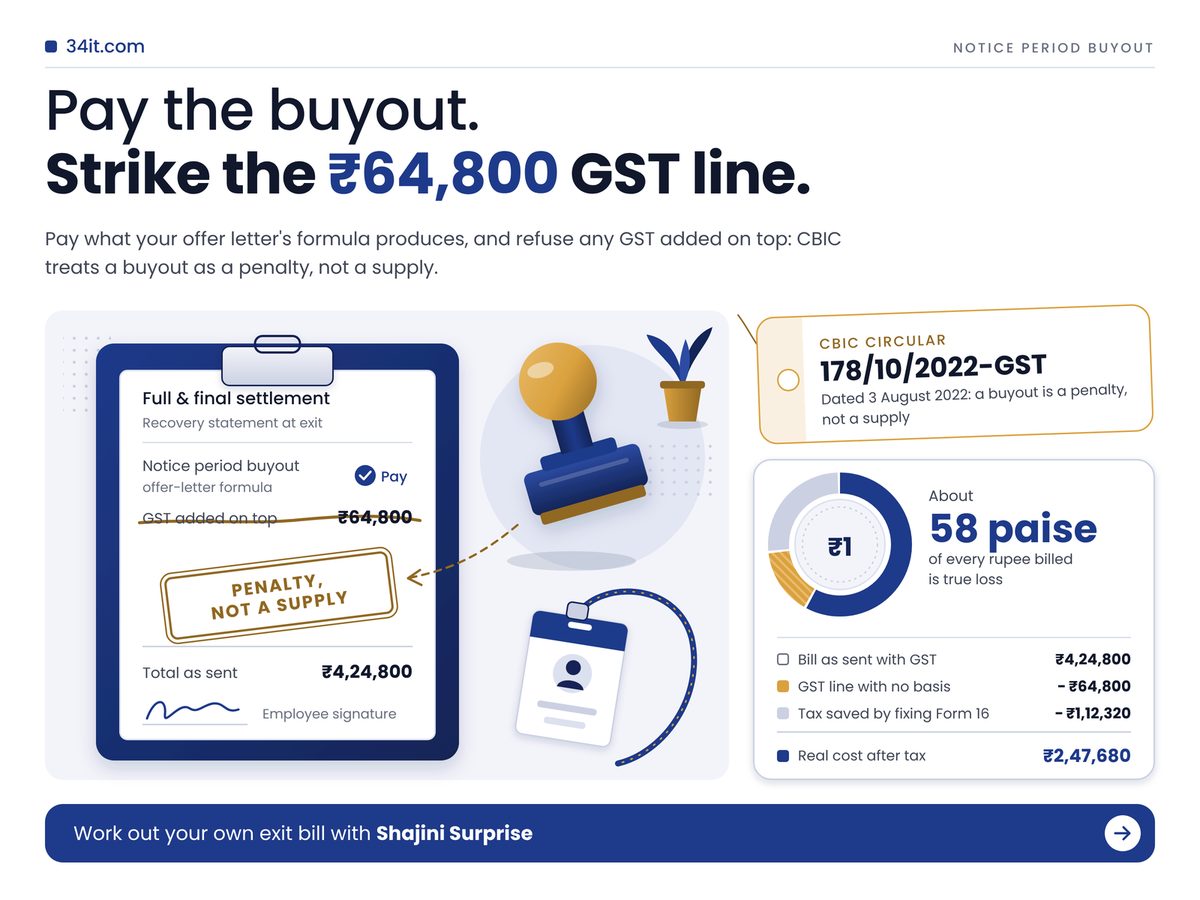
Notice period buyout bill with struck GST line, penalty stamp and rupee gauge

Key Takeaways: Pay your offer letter's buyout formula and refuse any GST added on top.

  • CBIC Circular 178/10/2022-GST (3 August 2022) treats salary forfeited for leaving early as a penalty, not a service, so no GST applies.
  • The Kerala and Gujarat High Courts have treated GST paid on notice pay as refundable.
  • An ITAT Ahmedabad ruling taxes only salary you kept, so the recovery should come off Form 16 income.
  • If your marginal tax rate tops 18%, fixing Form 16 saves more than refusing the GST.

Is GST applicable on notice period buyout?

No, GST does not apply to salary you pay back for skipping notice, because CBIC Circular 178/10/2022-GST treats it as a penalty that buys the employee nothing, so it is not consideration for any supply. Read the circular itself: paragraph 7.5 never says "notice period". It covers "forfeiture of salary" when an employee leaves before the agreed period, adding that the employee "does not get anything in return".

The Kerala High Court read notice pay into that line in Manappuram Finance (2022), as reported by Taxmann, and called the circular clarificatory, so it reaches exits before August 2022 too. The same paragraph covers an employment bond's proof problem.

The 18% line mostly traces to one Gujarat case. Amneal Pharmaceuticals' advance ruling, reported in November 2021, held GST payable. Its appeal split between the two members on 9 February 2022, and under CGST Act s.101(3) a split means no ruling issues. An HR policy citing Amneal cites nothing.

The practice outlived the law. An undated complaint on Medium says an employer "recovered the Notice period shortfall amount with 18% GST".

Four numbers set how hard you can push. They come from the Gujarat High Court's 2025 Aculife Health Care ruling (TaxGuru's report), the Model Standing Orders notified on 8 May 2026 (JSA's reading) and Code on Wages s.18.

Wages Due After Resignation

2 working days

Any netting must fit this

GST One Employer Paid on Notice Pay

₹45.14 lakh

Ruled never tax, refundable

Workers Before Standing Orders Apply

300

Smaller firm: contract alone governs

Cap on Listed Wage Deductions

50%

Of one wage period's pay

The refund card is a warning. Aculife paid the tax itself, and the court held it was never tax, with the two-year refund clock running from 3 August 2022. On that reading, pre-circular claims shut on 3 August 2024 (our arithmetic), so refuse GST at the bill. If your buyout runs on basic pay, see how the Code on Wages add-back reshaped basic pay.

"

The employee does not get anything in return. CBIC wrote that in 2022, and no HR invoice turns it back into a service.

What each line of a buyout bill should say

A correct buyout bill shows one line, the contract formula applied to the days you did not serve after leave set-off, with no GST, and your Form 16 should then show only the salary you kept. In Nandinho Rebello v. DCIT (18 April 2017), ITAT Ahmedabad taxed only the salary actually received after ₹2,76,744 of notice pay was held back, per BCAJ's case note. Your relief is your marginal rate on the recovery; GST is a flat 18%. Above an 18% marginal rate, Form 16 matters more than the GST, and most advice gets that order backwards.

Worked example: assume ₹2,40,000 monthly pay used for the buyout, a 90-day notice period, 30 days served, 15 leave days set off, and a 31.2% marginal rate (30% slab plus 4% cess). Unserved days: 90 minus 30 minus 15 is 45. A day's pay is ₹2,40,000 divided by 30, or ₹8,000, so the buyout is ₹3,60,000. Add 18% GST and the bill reads ₹4,24,800, of which ₹64,800 has no basis. Keeping the recovery out of taxable salary saves ₹1,12,320. Real cost: ₹2,47,680, or ₹1,77,120 below the bill. Try your own pay below; it takes under a minute.

What does your buyout really cost?Set the pay your contract uses, your notice terms and your tax rate. The split shows what you truly lose, the tax you should not pay, and the GST line to refuse.
Your numbers
Buyout under your formula₹3,60,000
GST line to refuse₹64,800
Tax you should not pay₹1,12,320
Real cost after tax₹2,47,680
Your tax line, ₹1,12,320, is bigger than the GST line, ₹64,800: fix Form 16 as well as the bill.Sliders need JavaScript. Figures shown are the article's example.Monthly pay divided by 30, times unserved days: a common offer-letter convention, your contract decides basic or gross. GST should be nil per CBIC Circular 178/10/2022-GST (3 Aug 2022). Not legal advice.

Find the row matching your exit bill and read across.

If you Do this Because
๐Ÿงพ See GST billed Ask HR to delete it in writing Circular 178, para 7.5: not a supply
๐Ÿ’ฐ Quoted flat sum Pay the offer-letter formula only Contract Act s.74 caps it at the named sum
๐Ÿ“Š Form 16 gross Ask for salary net of recovery At the 30% slab, ₹31,200 saved per ₹1 lakh
⚖️ Face F&F netting Consent in writing after checking the sum s.18 lists no buyout deduction
๐Ÿ›  None apply Pay the formula sum, keep the receipt Proof the contract is settled

On the flat-sum row, Indian Contract Act s.74 limits breach compensation to a reasonable amount no higher than the sum the contract names.

Where a GST-loaded buyout bill really goes

58.3% 26.4% 15.3% Real cost of the buyout after tax Income tax you should not pay on it GST added with no legal basis

Of every rupee on a GST-loaded buyout bill, only about 58 paise is a true loss, so win back the other two slices first. Derived from the worked example, with GST nil per Circular 178/10/2022-GST.

Can notice pay be deducted from full and final settlement?

In practice yes, employers net a buyout from your full and final settlement under the contract or your signed consent, though Code on Wages s.18 does not list notice recovery among the deductions it permits from wages. That is the grey area. Our view: netting rests on your contract and consent, not the Code, so ask for it in writing and challenge any figure above the formula. We found no ruling that tests this under the new Code.

Covered establishments must issue a service certificate within 10 days of resignation under the 2026 Model Standing Orders, so holding it over a disputed GST line is their problem. Each leave day set off also cuts the buyout by a day's pay; weigh that against the leave encashment rules (or, more precisely, what your policy pays per day).

  • Rebello is a 2017 tribunal ruling; outside Gujarat it persuades but does not bind your assessing officer.
  • JSA flags state exemptions such as Karnataka's for IT and ITES firms.
  • Pay the undisputed formula amount on time, so only the GST stays open.

Before you pay, check four things

  • Your exit bill shows a line marked GST, CGST, SGST or IGST.
  • Your offer letter names the days and basic or gross.
  • Your Form 16 Part B shows gross salary before the recovery comes off.
  • HR can show certified standing orders that cover your role and state.

The decision is to pay the formula, not the invoice. This week, before signing your F&F, email HR asking them to remove the GST line under Circular 178/10/2022-GST, paragraph 7.5, and to issue Form 16 net of the recovery. This is wrong only if the bill shows no GST and Form 16 is already net, so check Part B first.

How we checked this

We read CBIC's Circular 178/10/2022-GST (3 August 2022) in full, the Gujarat High Court's Aculife ruling (2025) in TaxGuru's report, ITAT Ahmedabad's Rebello order (18 April 2017) in BCAJ's note and JSA's May 2026 note on the Model Standing Orders. The worked example assumes ₹2,40,000 monthly pay, 45 unserved days and a 31.2% marginal rate. No exit bill was audited first-hand, and none of this is legal or tax advice. Last verified: 30 October 2026.

Edited by Shajini, reviewed after publication. Spotted something out of date? Tell us and we will correct it.
Saturday, October 24, 2026

Retrenchment Compensation, Plus 15 Days

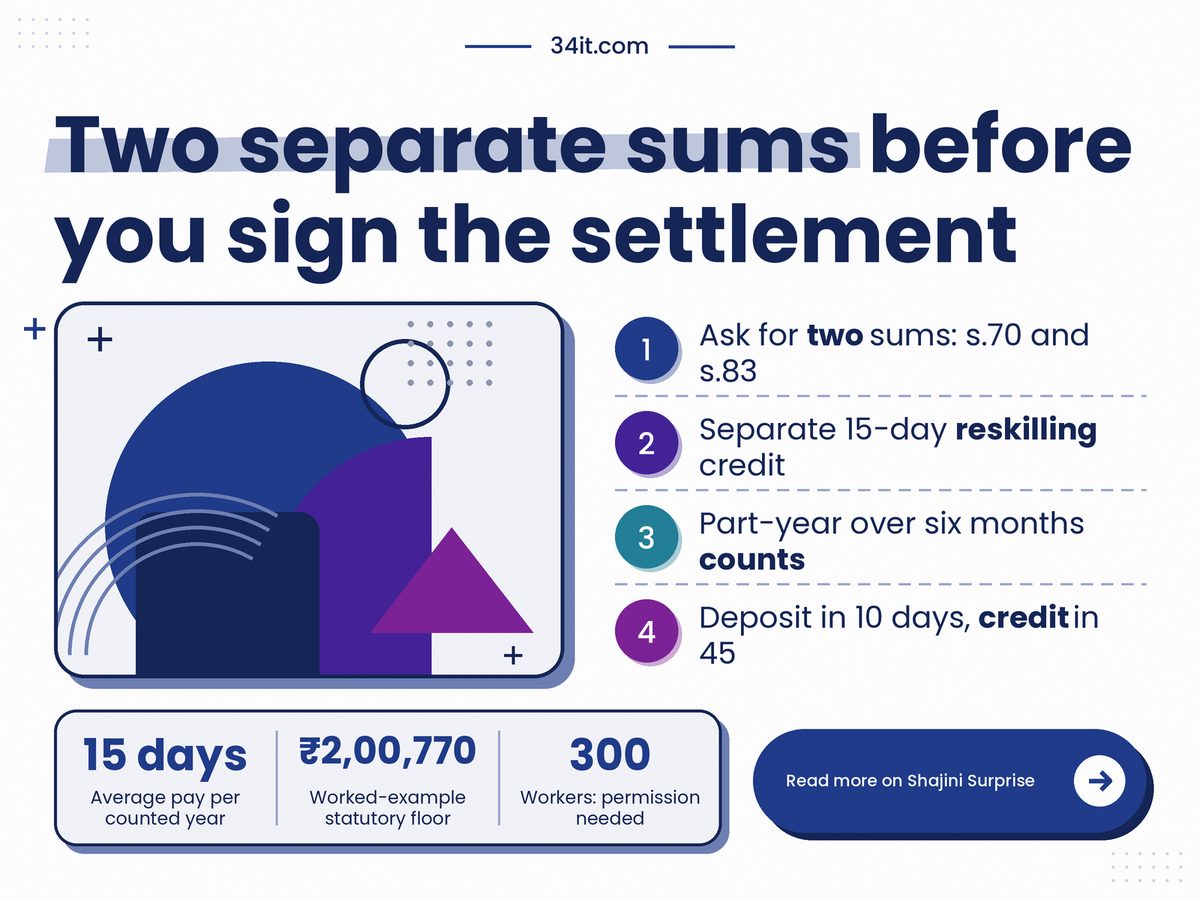
Section 70 of the Industrial Relations Code, 2020 lets an employer retrench a worker with one year of continuous service only after three steps: a month's written notice giving reasons (or a month's wages instead), a notice to the government, and retrenchment compensation of 15 days' average pay for every completed year. Section 83 then adds a second, separate 15 days. An exit statement that shows one line for both has short-paid you.

Featured image listing retrenchment compensation and the separate 15-day reskilling credit figures

Key Takeaways: a retrenched "worker" with a year's service is owed two separate sums: 15 days' average pay per counted year, and a 15-day reskilling credit paid through a government fund.

  • Any service beyond six months past your last work anniversary counts as a full year.
  • The base is Code "wages", so allowances above half your pay are added back.
  • Supervisors above the notified pay line, and anyone in a mainly managerial role, fall outside both sums.
  • Check the reskilling credit first; it has its own deadline.

How is retrenchment compensation calculated in India?

You multiply 15 days' average pay by your completed years of continuous service, counting any part-year over six months as a full year, where average pay is your Code wages over the last three complete calendar months.

Two definitions do the work. "Wages" in s.2(zq) leaves out items such as HRA and conveyance, but if those exceed half of total pay, the excess is added back. That is the proviso behind the 50% wage rule that cut take-home pay, and here it works for you: a thin basic no longer shrinks the base.

Timing decides which law applies. A Ministry of Labour release (PIB, 8 December 2025) confirms all four labour codes came into force on 21 November 2025, so a later retrenchment falls under this formula, not the Industrial Disputes Act of 1947. Our view: any guide still built on the 1947 Act describes the wrong payout, since that Act had no reskilling credit. Gratuity stays a separate claim; see the new gratuity rules on one year of service.

Four thresholds in the Code (Act 35 of 2020) decide whether the formula reaches you, and how big the base is:

Rehire Preference Window

12 months

Keep your retrenchment letter safe

Supervisor Pay Line

₹18,000 a month

Supervisors above it lose cover

Headcount Needing Permission

300 workers

Old Act's line was 100

Allowance Cap in Wages

50% of pay

Excess raises your compensation base

The allowance cap moves the most money for IT staff. A lean basic with a fat flexible component used to shrink every statutory payout; now the excess flows back into wages. Check the base against your last three pay slips, not your offer letter.

"

Your job title does not decide whether you are owed both sums. What you do all day decides it, and for supervisors, one pay line.

What your exit should pay, by years and wage

For IT workers on ₹30,000 to ₹60,000 of monthly Code wages with two to twelve counted years, the two statutory sums together run from roughly half a lakh to four and a half lakh rupees, before notice pay.

Worked example: take an engineer in a firm below the permission headcount, retrenched after 4 years 7 months, on a monthly gross of ₹90,000: basic ₹36,000, HRA ₹18,000 and ₹36,000 of other excluded allowances. Excluded items total ₹54,000, which is ₹9,000 over half the gross, so Code wages are ₹36,000 + ₹9,000 = ₹45,000. Assume a 26-day month: ₹45,000 ÷ 26 × 15 = ₹25,961.54 per 15-day block. Seven months is more than six, so service counts as 5 years, and s.70 pays 5 × ₹25,961.54 = ₹1,29,808. The s.83 credit is one more block, ₹25,962, paid once. A month's wages in lieu of notice adds ₹45,000. On the rounded figures, the statutory floor is ₹2,00,770. A 30-day divisor pays less, so check which one your employer used.

Find your counted years, then read across at your monthly Code wages; each cell is s.70 compensation plus the s.83 credit.

Years counted ₹30K/mo ₹45K/mo ₹60K/mo
2 yrs ₹0.52L ₹0.78L ₹1.04L
5 yrs ₹1.04L ₹1.56L ₹2.08L
8 yrs ₹1.56L ₹2.34L ₹3.12L
12 yrs ₹2.25L ₹3.38L ₹4.50L

The shaded cell, 5 counted years at ₹45K, is the worked example minus notice pay; each extra counted year adds ₹17,308 in the left column and ₹34,615 in the right. Your one-minute check: count the months since your last work anniversary, because anything beyond six adds a year. At or above the permission headcount, s.79 demands three months' notice, lifting the example's notice pay to ₹1,35,000 and its floor to ₹2,90,770.

Where the worked example's floor goes

Floor three parts 65% s.70 compensation 22% notice pay 13% s.83 credit

The reskilling credit is the smallest slice but the only one with its own government deadline, so chase it separately. Shares are derived from the ₹90,000-gross, 4-years-7-months example.

Is a software engineer a "worker" under the Code?

In most cases yes, because s.2(zr) covers technical and skilled work done for hire, and for private IT staff it excludes only people employed mainly in managerial or administrative roles and supervisors whose wages exceed the notified monthly line.

The test is what you do, not what HR calls you. An engineer who codes all day is a worker at any salary; a lead who signs off leave and appraisals is likely "supervisory", and above the pay line loses both sums. The grey area, in our view: the Code never defines "mainly", so a lead who still spends most hours on delivery has a fair argument to stay inside.

The credit runs on its own clock. PRS Legislative Research's summary of the Industrial Relations (Central) Rules, notified on 8 May 2026, says the employer deposits 15 days' last-drawn wages within 10 days of retrenchment and the worker is credited within 45 days. The Code counts from retrenchment; the Rules, as PRS reads them, from the deposit. So the outer limit is day 55 (or day 45, if your state follows the Code's wording; most private IT firms answer to state rules). Firms at the permission headcount must also apply at least 60 days ahead, and s.79(7) makes a retrenchment without permission illegal.

Before you sign, check that:

  • your letter says retrenchment, with no misconduct and no resignation named;
  • the statement names its day divisor and the three months it averaged;
  • if your title says lead, most of your week is delivery, not sign-offs;
  • s.70 compensation and the s.83 credit appear as separate lines.

The decision is whether to sign, and the answer is only when both sums are on the page. If yours shows one, write to HR this week for the s.70 figure, the s.83 deposit date and the divisor used; if the credit misses the outer limit, raise it on the Ministry of Labour's SAMADHAN portal after checking your state's rules. This is wrong for you only if your role was mainly managerial, where your contract governs instead.

How we checked this

We read the Industrial Relations Code, 2020 (ss.2, 70, 72, 79, 83), the Industrial Relations (Central) Rules, 2026 (notified 8 May 2026), PRS's bill-track summary and the PIB release of 8 December 2025. The worked example assumes ₹90,000 gross, ₹36,000 basic, a 26-day month and 4 years 7 months of service. No product was tested hands-on for this article, and no employer's settlement was reviewed. Last verified: 24 October 2026.

Edited by Shajini, reviewed after publication. Spotted something out of date? Tell us and we will correct it.
Wednesday, October 21, 2026

Who Pays for Work Phone Bills in India?

Your manager asks you to take client calls on your own SIM card. The bill that month is ₹900, and HR offers a flat ₹500 "towards mobile". Who pays for work phone use in India depends less on the request than on how the money reaches you, and the tax difference is real.

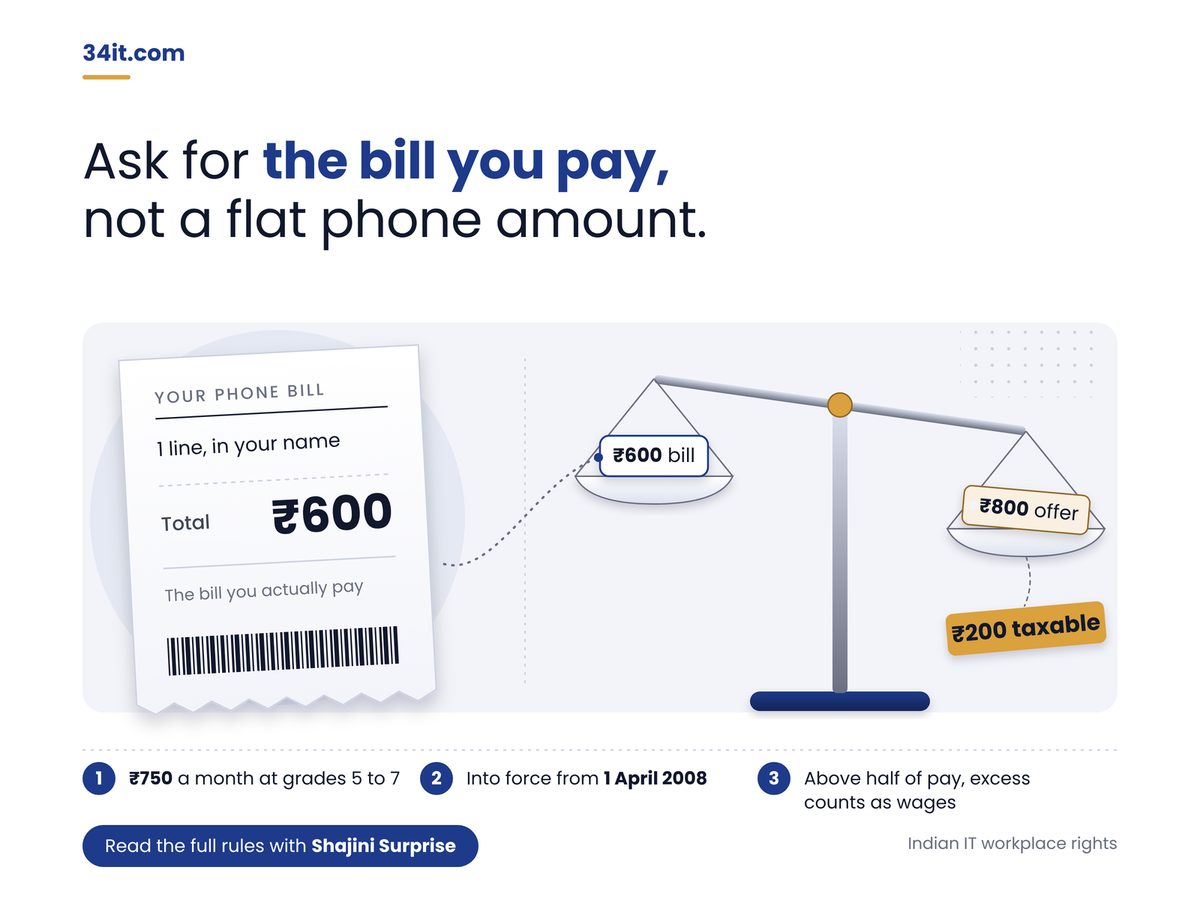
Who pays for work phone bills? A bill receipt weighed against a flat offer.

Key Takeaways

Who pays matters less than how. A reimbursed bill can stay outside salary, while a flat phone amount is taxed as pay.

  • A fixed phone stipend with no bills is added to salary and taxed.
  • A bill-backed claim is exempt only up to the lower of the bill or the amount offered, so any surplus is salary.
  • Usually one connection in your name, so family plans fall outside.
  • Section 2(y) of the Code on Wages can pull a large phone allowance back into wages.

Who Pays for Work Phone Use, and Why the Bill Matters

None of the sources we checked says whether a law requires an employer to pay for a work phone, but if yours does pay, the tax result turns on whether it reimburses your bill or pays a flat amount.

Rule 3(7)(ix) of the Income-tax Rules, 1962 values most other perks at arm's-length cost to the employer, but its proviso takes telephone expenses, mobile phones included, that the employer actually incurs on your behalf out of that method. Pluxee's 2026 guide and ClearTax both read the proviso as an exemption when bills back the claim. For you, a bill your employer pays is not valued as a perk.

The flat route is harder to defend. Pluxee's guide says a fixed monthly stipend with no bills is added to salary and taxed, and a BYOD stipend is taxable unless an invoice backs it. That means you pay for the phone out of money already taxed as salary, with no bill to show for the work use. Our post on the wage rule's one-half test explains the threshold, and which US states make employers pay for a personal phone used at work shows how another country handles it.

Four numbers decide most of this, and each traces to a named source. Pluxee's guide, dated 13 March 2026, reproduces one firm's HR table, ₹750 a month at grades 5 to 7. ClearTax, undated and retrieved 21 October 2026, supplies the one-connection condition. A 2007 notification put the phone-expense proviso into force from 1 April 2008, and section 2(y) of the Code on Wages, 2019 sets the one-half test.

Years in Force

18 years

The rule a bill claim rests on

Monthly Flat Amount

₹750 a month

One firm's flat amount, grades 5 to 7

Connections Covered

1 line

Usually the only exempt connection

One-Half Test

50%

Above half of pay, excess counts as wages

Section 2(y) asks one question: is a payment a genuine cost of the job, or pay under another name? Clause (e) excludes sums that defray special expenses of the employment, but the one-half test still counts those sums, and any excess goes back into wages. Past that point, a phone allowance is salary by another route.

"

A flat phone amount is salary, whatever HR calls it. A bill is a receipt, and the exemption rests on receipts.

Bill Claim or Flat Stipend: How They Differ

A bill claim and a flat stipend differ on four points: tax, amount, proof and whose line counts, and each row below takes one of them.

Read each row against the offer you have. The middle column gives both routes, and the right column says what it means for your pay.

What differsBill claim vs stipendFor you
๐Ÿ’ฐ TaxBill claim Not taxed as pay
Stipend Taxed as salary
✅ Keeps phone money out of pay
๐Ÿ“Š AmountBill claim Lower of bill or offer
Stipend Fixed sum
⚠️ ₹600 bill, ₹800 offer: ₹200 taxable
๐Ÿงพ ProofBill claim 1 bill a month
Stipend No bill
❌ No bill, no exemption
๐Ÿ”’ LineBill claim 1 line, in your name
Stipend Fixed sum
⚠️ Family plans usually fall outside
๐Ÿ Best suitedBill claim Firms that reimburse bills๐Ÿ Anyone keeping monthly bills

Take last month's phone bill and the amount your employer offers, and put the two side by side. The exemption follows the smaller figure, so anything the offer adds above your bill is salary. Then check the proof: is the line in your name, and does the bill show your number? Those two answers tell you which column you are in.

๐Ÿ’ฐ
Bill claim
Lower of bill or offer

๐Ÿ’ธ
Flat stipend
Taxed as salary

๐Ÿงพ
Bill in your name
The proof you need

๐Ÿ”’
One line
Usually all that is covered

Ask for the bill, not a flat phone amount, because bill-backed claims can stay outside salary and flat stipends cannot. Source: Pluxee's 2026 guide and ClearTax, both summarising Rule 3(7)(ix).

Where Phone Claims Go Wrong

A phone claim can fail on paperwork rather than on the rule, because the bill may sit in someone else's name or cover a family plan. Check both before you ask for reimbursement.

The connection rule is the one to check first. ClearTax describes the exemption as covering usually one connection, in the employee's name, with a bill shown and business use. A family plan or a second SIM sits outside that, even if you use it for work calls. If you use a voice-only recharge, read how a voice-only recharge changes your bill.

Watch the amount too. Pluxee reproduces one firm's HR table, and a flat sum like that is the kind that gets taxed unless a bill backs it. My read, not a sourced finding, is that whether an employer can insist you use your own phone is still an open question, so get the policy in writing rather than rely on a verbal promise.

  • Your employer calls a flat amount a "phone bill".
  • Your claim covers a family plan.
  • Your bill is in a colleague's name.
  • Your phone has no record of work use.

Key Takeaways to act on

  • Your line is in your name and is not a family plan.
  • Your bill shows your name and your number.
  • Your work calls and messages run on that same number.
  • Your offer is a bill claim, or HR agrees to make it one.

Ask for the bill you actually pay, not a flat phone amount, because a bill-backed claim is the route the exemption covers. So the decision in front of you is a bill claim or a flat stipend, and the bill wins on tax. Ask HR this week to reimburse the bill in writing, and ask for the policy before you accept any allowance.

Thursday, October 15, 2026

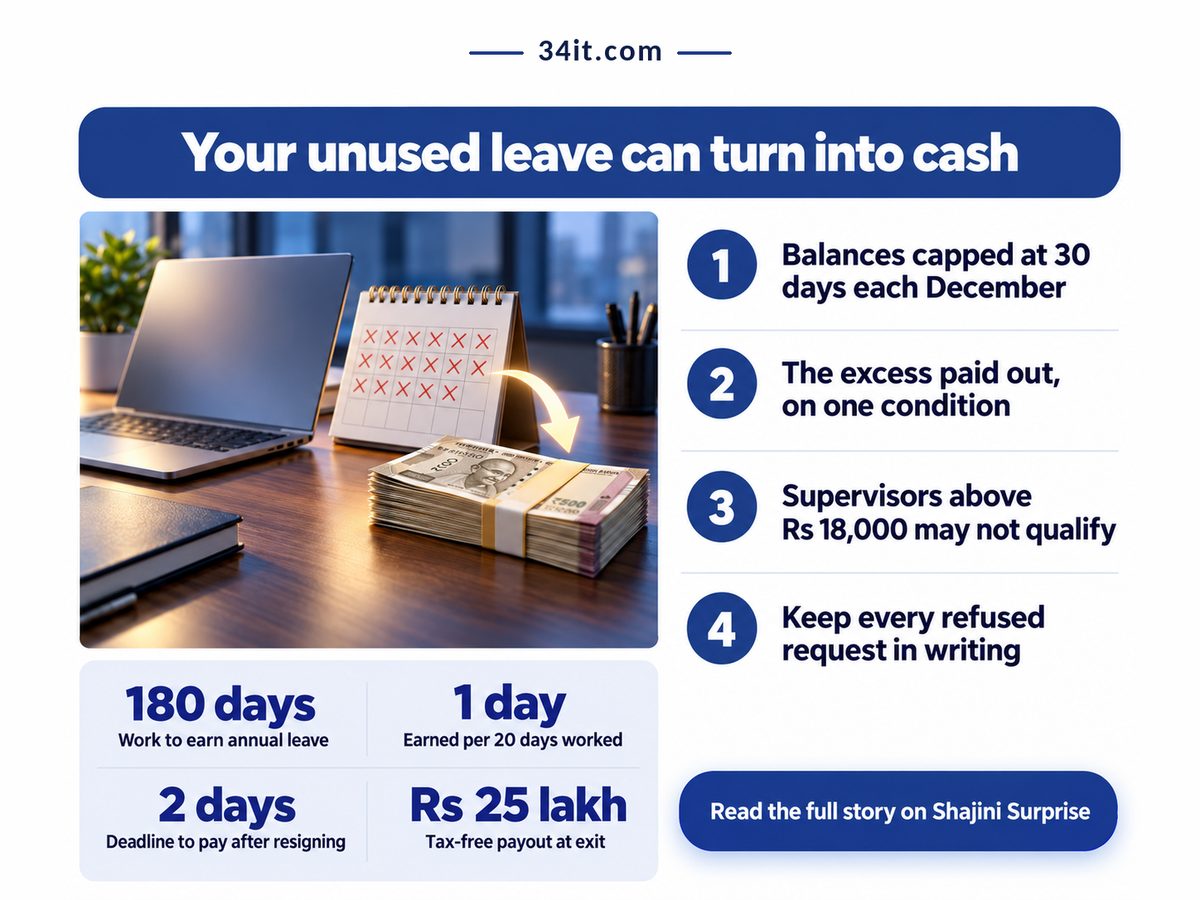
Leave Encashment Rules: Day 31 Gets Paid

Section 32 of the Occupational Safety, Health and Working Conditions Code, 2020, in force since November 2025, lets a worker carry no more than 30 days of annual leave into the next calendar year. Day 31 is not forfeited. Under the new leave encashment rules, the excess can be paid out in cash when the year closes, but the clause puts the burden on you: the money follows a request, not the calendar.

Leave encashment rules infographic showing a desk calendar, rupee notes and four key points

Key Takeaways: leave above the carry-forward cap does not vanish: a worker can ask for it to be paid in cash when the calendar year ends.

  • Leave you applied for and were refused carries forward with no ceiling, so keep the rejection email.
  • Joiners after roughly the end of April cannot qualify this calendar year, yet accrued leave is still paid at exit.
  • Year-end encashment is taxed as salary, while exit payouts sit inside a large exemption.

How many earned leaves can be carried forward under the new labour code?

A worker can carry forward up to 30 days of annual leave into the next calendar year, and any leave that was applied for and refused rides on top of that cap with no limit at all.

That second half is the clause worth printing. JSA Law's April 2026 analysis of section 32 reads it plainly: refused leave escapes the cap, and the balance above the cap is encashable on demand at year end. A manager who rejects your December leave has moved those days outside the ceiling. Keep that email; it proves the days were refused, not simply untaken.

The cap itself is the least interesting part of the rule. What is new for IT staff is a national floor no policy can undercut, and a payout trigger the employee controls.

It sits beside the pro-rata gratuity rule for fixed-term IT staff and the 50% wage rule that cut take-home pay, and shares their weakness: each protects only the people the Code calls workers. Four numbers decide whether you have leave to encash at all. Outlook Money (25 March 2026) and People Matters (14 April 2026) report the threshold, accrual rate and wage line; the annual floor is this article's arithmetic over a full working year.

Days Worked to Qualify

180 days

About two months sooner than before

Accrual Rate

1 per 20

Policies may beat it, never undercut

Annual Leave Floor

About 12 days

Your offer letter can only exceed it

Supervisor Wage Line

₹18,000/month

Above it, you may be out

The accrual rate is the one to check against your offer letter. Most IT policies already beat it, which is fine: the Code sets a floor, not a ceiling. It bites for the employee on a lean contract, whose policy cannot quietly drop below it.

"

A supervisor paid above the wage line may sit outside section 32 entirely. Your duties, not your designation, decide whether any of this protects you.

Leave encashment rules at a glance

The rules split into two payouts: a year-end encashment of leave above the cap, paid only when a worker asks, and an exit payout of the whole balance, owed on any exit whatever the tenure.

Exit timings come from Simpliance's section 32 summary (undated, retrieved 16 October 2026, not the Gazette text); the tax line is the CBDT's 2023 change to section 10(10AA). The joiner cut-off is this article's own reasoning: at five days a week the eligibility threshold takes about 36 weeks of work, so a joiner after roughly the end of April cannot reach it by 31 December.

Category Detail What it means
๐Ÿ’ฐ Year-end cash Days above the 30-day cap, on written request ⚠️ Taxed as salary in that year
๐Ÿงพ Exit tax Exempt up to ₹25 lakh, non-government staff ✅ Most exit payouts land tax-free
⏱ Exit payout Before the 2nd working day after you leave ✅ Chase it with the F&F, not later
๐Ÿ“Š Short tenure Accrued days paid even below the threshold ✅ A six-month leaver is still owed
⚖️ Refused leave Carried forward with no upper limit ✅ A rejection email beats the ceiling
⏱ Joiner cut-off Start work after about 1 May ❌ Nothing to take until next January

The exit payout protects you automatically; the year-end payout protects you only if you act. One caveat: excess days cashed in December are taxed at your slab, whereas the same days paid at exit would fall inside the exemption. Unclaimed days may lapse under company policy, so ask anyway.

1. 2. 3. 4. 5. 31 Dec. Carry. Encash. Refused. Exit. 42 banked. 30 roll over. 12 on request. Added, uncapped. All paid out.

If your balance will pass the cap on 31 December, a written encashment request is the only way to keep the extra days' value; refused leave carries over regardless. Worked example derived from section 32 as analysed by JSA Law (April 2026); the 42-day balance is illustrative.

Does the new labour code apply to IT employees?

It applies to IT employees who qualify as workers, which typically covers individual contributors, but managerial and administrative staff, and supervisors earning above the wage line, fall outside the leave protections in section 32.

Titles in IT are inflated, so ignore yours. A lead with no reports may still be a worker; an associate manager who signs off appraisals may not be. Check your job description for supervisory duties.

Outlook Money and People Matters both report that several states have not notified final rules; where yours has not, its Shops and Establishments Act still sets your leave terms. Whether a policy that lapses leave above the cap survives for workers is, in my view, the open question. My reading is that it should not, since a lapse clause and an encash-on-demand clause cannot both be honoured (at least not until a labour court says which wins).

On exit, the leave payout runs on the same clock as India's 48-hour full and final settlement deadline, so a month-long settlement cycle is late on this line item too. Watch for these:

  • A policy line saying leave above the cap lapses on 31 December.
  • A refused leave request that exists only as a verbal no.
  • A settlement statement that leaves out leave wages for a short-tenure exit.

Check these before 31 December

  • Nobody reports to you, or your pay sits below the supervisor wage line.
  • Your balance on the last working day of December will exceed the carry-forward cap.
  • At least one refused leave request is saved as an email or HR-system record.
  • Your state labour department lists its OSH Code rules as notified.

Tick the first two and the payout is yours to claim.

The decision is whether to ask, and for any worker heading past the cap the answer is yes. This week, check your balance against the ceiling, save every refused-leave email to a folder you control, and send HR a two-line written request to encash the excess on 31 December.

Thursday, October 8, 2026

Your Employment Bond Has a Proof Problem

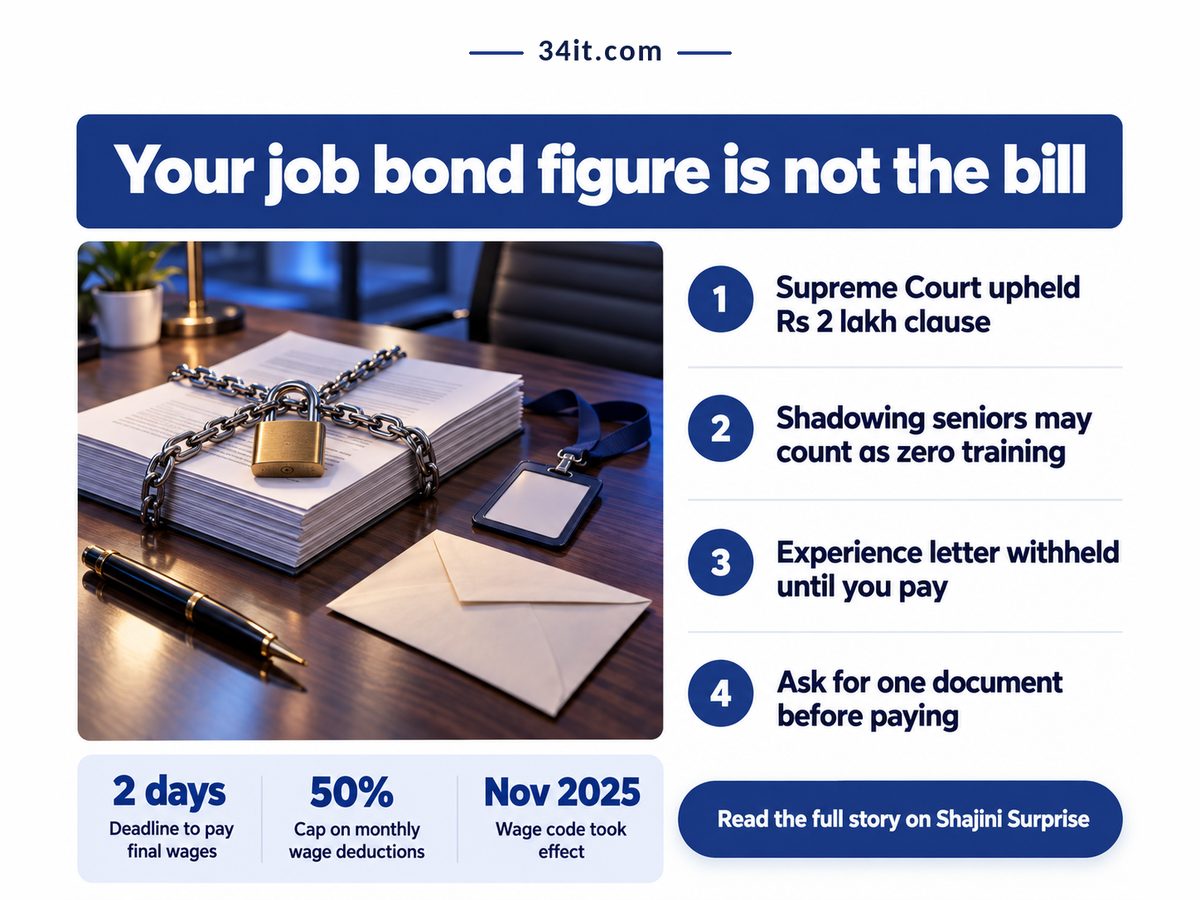
The clause usually sits a few pages into the offer letter, under a heading like Service Agreement: leave before a fixed term ends and you pay a stated sum as liquidated damages for training. Freshers at Indian IT services firms sign it on joining day. That employment bond is enforceable more often than office WhatsApp groups claim, but the printed number is where your employer's case starts, not where it ends.

Padlocked employment bond contract on a desk beside four points on recovery limits

A bond can be enforced, but only for training cost your employer can prove, reduced for the time you served, and never by cutting it from your final salary.

  • The Supreme Court upheld a bank's bond clause in May 2025, so calling every bond void no longer works.
  • The stated sum is a ceiling; courts cut damages for months served and thin training.
  • Training recovery is not a permitted wage deduction, so it cannot come out of your full and final settlement.
  • Before paying anything, ask HR in writing for the itemised training-cost record.

Is an employment bond legal in India now?

Yes, a bond that ties you to a minimum service period is generally enforceable in India after the Supreme Court's 2025 ruling, but only for loss the employer can show and in proportion to your pay.

The case is Vijaya Bank v Prashant B. Narnaware, decided by the Supreme Court on 14 May 2025. An officer agreed to serve three years or pay ₹2 lakh, then left early. The Court held that a covenant operating during employment is not a restraint of trade under section 27 of the Contract Act. Quoting section 27 at HR no longer ends the conversation; the fight is now over amount and proof.

The win is narrower than it looks. According to Bharucha & Partners' note on where bonds stand now, the sum was held non-penal because the bank bore real recruitment cost and the officer was a senior middle manager who could pay. My reading is that the ruling quietly helps freshers, since proportionality to pay is now part of the test.

It also binds less than it seems. Vijaya Bank is a public sector bank, so for a private IT firm the judgment is persuasive, not binding, as one May 2025 post-ruling analysis notes. Tenure also moves your gratuity under the 2026 rules too. If the company is easing you out, through silent layoff signals tech workers miss, keep every email: in my view that weakens its claim to damages.

Four numbers decide what you hand over. Two come from the Code on Wages, 2019, in force since 21 November 2025. Two earlier rulings Bharucha cites, Ledalla Ravichandar v Satyam and Sicpa India v Manas Pratim Deb, cut damages for time served and pay scale. Saurabh Seth, in Bar & Bench on 24 January 2026, valued on-the-job training; that is practitioner opinion, not a ruling.

Deadline for Final Wages

2 working days

Pay cannot wait on disputes

Recoverable Cost of Shadowing

₹0

If KT was your training

Rulings Cutting Bond Damages

2

Time served lowers the bill

Cap on Deductions per Wage Period

50%

Half your pay stays protected

Take the deadline: under section 17(2), HR cannot park your last salary during a bond dispute. Section 18 lists every permitted deduction, from fines and advances to tax and court orders, and training recovery is not on it. The lawful route is a civil suit.

"

A bond is a claim your employer has to prove in court, not a line it gets to subtract from your last payslip.

So what does a court actually allow when you leave early?

What happens if you break a training bond?

If you leave before the bond period ends, your employer can claim damages, but courts tend to cut the stated sum to proven training cost, reduce it for months served, and the claim has to go through a suit.

In the middle column, the first line is the bond and the second is what courts and the Code have allowed.

Dimension Bond vs court What it means for you
๐Ÿ’ฐ Amount owed Bond full sum, any exit date
Court proven loss, s.74 ceiling
✅ The printed figure is a maximum, not a bill
⏱ Time served Bond same sum at any month
Court month 30 of 36, a sixth left
✅ Each month you stay shrinks the claim
๐Ÿ›  Training proof Bond training left undefined
Court invoices, dates, trainers
⚠️ Thin paperwork weakens their case
๐Ÿ“Š Pay scale Bond one sum for every grade
Court 2025 test weighs your pay
⚠️ Freshers hold the stronger fairness case
๐Ÿงพ Final pay Bond netted from your F&F
Court s.18 list has no bond line
✅ Your last salary arrives untouched
⚖️ Exit papers Bond letter held till paid
Court no lien on documents
✅ Refuse the swap and keep it in email
๐Ÿ”’ Notice gap Bond rolled into the bond sum
Court unserved days' pay only
❌ You still owe this, as a separate sum
๐Ÿ Best suited for Pay classroom spend proven
Contest training was only shadowing
๐Ÿ Ask for the record before deciding

Five of eight rows favour you or turn on paperwork the employer controls. Classroom training with invoices is a real claim; shadowing mostly is not.

Served: 24 months. Unserved: 12 months. Two thirds of the term. One third. ₹1,33,333 no longer at stake. ₹66,667 maximum at stake.

Leaving at month 24 of a three-year, ₹2 lakh bond puts at most about ₹66,667 at risk, less if receipts are thin. That is our own pro-rata arithmetic on the Vijaya Bank terms, not a court's figure.

Can HR hold back your experience letter or final pay?

No, withholding your experience letter until you pay the bond is pressure rather than a legal remedy, and your final wages fall due on time whatever the bond dispute, so put every demand in writing.

Seth calls trading a bond payment for an experience letter illegal leverage. It still works more often than it should (a missing letter stalls the next background check). Specific performance of a service contract is barred, so the most a bond becomes is a money claim.

Notice is separate. Skip part of it and, on Seth's reading, you owe at most salary for the unserved days, never bundled into the bond figure. Check the payment date against the 48-hour full and final settlement deadline, and watch for:

  • A bond letter with one lump sum and no cost breakdown.
  • A training recovery line on the F&F statement, a separate issue from the wage-definition rule that reshaped take-home pay.
  • Notice pay and bond damages merged into one figure you are asked to sign.

Key Takeaways to act on: check these before you pay

  • Your offer letter names a training cost, not only a penalty.
  • HR can show invoices or trainer records for your batch.
  • Your training was a formal programme, not shadowing.
  • Less than a sixth of the bond term is left to run.

Two or more false: contest rather than pay.

The decision is whether to pay or contest, and it turns on one document. This week, email HR for the itemised training-cost record behind your bond and state that you expect your final wages in full. If the record exists, offer your unserved share of the proven cost. If it doesn't, decline and let the company decide whether a suit is worth it.

Related: why a notice period buyout carries no 18% GST under CBIC Circular 178/10/2022

Related: joining bonus clawback