Who pays for a work phone is a question most Indian employees never actually ask, because the answer arrived by default the day someone in HR said "just use your personal number for now" and nobody ever revisited it. Some companies hand you a device. Most just expect the calls to happen, on your SIM, on your bill, indefinitely.
There is no single Indian law forcing an employer to reimburse a personal phone used for work. It runs on company policy and your own contract, which means three very different outcomes are all equally common.
- Company-issued device: the employer owns the SIM, the handset, and the bill.
- A fixed monthly allowance: paid whether you used Rs 200 or Rs 2,000 of it.
- Bring your own, no reimbursement: the default in most small and mid-size Indian offices.
Who Pays For A Work Phone, By Policy?
Whoever your employment contract or HR policy names, since Indian labour law sets no general floor for phone reimbursement the way it does for statutory bonuses or provident fund contributions.
That absence matters more than it sounds. It means the decision genuinely comes down to what was negotiated, written down, or simply assumed at your specific company, and assumed is doing a lot of work in that sentence. A field sales role that lives on the phone gets an allowance almost everywhere, because the cost of not paying it shows up quickly in missed calls and slower response times that management notices. A desk role that takes the occasional work call rarely does, even though the phone, the data plan and the wear on the handset are all still real costs landing on one person's account, spread quietly across twelve monthly bills that nobody in HR ever sees added up. Chasing that gap once it is in dispute feels a lot like fighting an automated support loop that was never designed to hear your specific case.
Statutory Phone Mandate
None
Runs on contract, not law
Voice-Only Yearly Cost
Rs 1,849
Airtel, calls and SMS only
Bundled Yearly Cost
Rs 3,599
2GB a day added on top
Gap An Allowance Could Cover
Rs 1,750
A year, on the numbers alone
No regulator is coming to settle who pays for a work phone. The number only moves once someone in your specific office writes it down.
The Three Ways Companies Actually Handle It
A company-issued device is the cleanest option on paper, since the employer owns the SIM, sets the plan and carries every rupee of the bill without touching your personal number at all.
A fixed monthly allowance is the middle ground, paid on top of salary regardless of what you actually spend that month, which works well for a role with predictable call volume and badly for one that spikes around a deadline or a client emergency. Bring-your-own-device with no reimbursement is the quiet default almost everywhere else, and it survives mostly because nobody totals up the real annual cost the way operators had to total up the fraud risk before the KYC display-name rules landed. Written down and added up over a year, a personal number carrying work calls is not a favour. It is an unpaid subscription, renewed automatically every recharge cycle without anyone signing off on the price. Ask three colleagues at three different companies which of these three arrangements they are actually in, and do not be surprised if none of them can answer immediately, because most people have never had to add the number up.
| Arrangement | Who Pays | Best Suited For |
|---|---|---|
| Company-issued device | Employer, 100% of the bill | Client-facing or heavy call-volume roles |
| Fixed monthly allowance | Split, one flat sum paid all 12 months regardless of use | Predictable, moderate call volume |
| Actual-bill reimbursement | Employer, against submitted receipts | Irregular usage spread across 12 months |
| Bring your own, unpaid | You, in full, every year | Nobody, honestly, but very common |
| Second SIM, voice-only | Rs 1,849 a year if self-funded | Calls and OTPs only, no work apps |
Notice where a second SIM sits in that table. It is the cheapest fix available to you personally, and it does not require your employer to agree to anything at all.
When A Second, Voice-Only Line Makes Sense
A voice-only second SIM makes sense the moment work calls are the entire requirement, since a role that never needs the work number to run an app or browse on the move has no reason to pay for a bundled data pack.
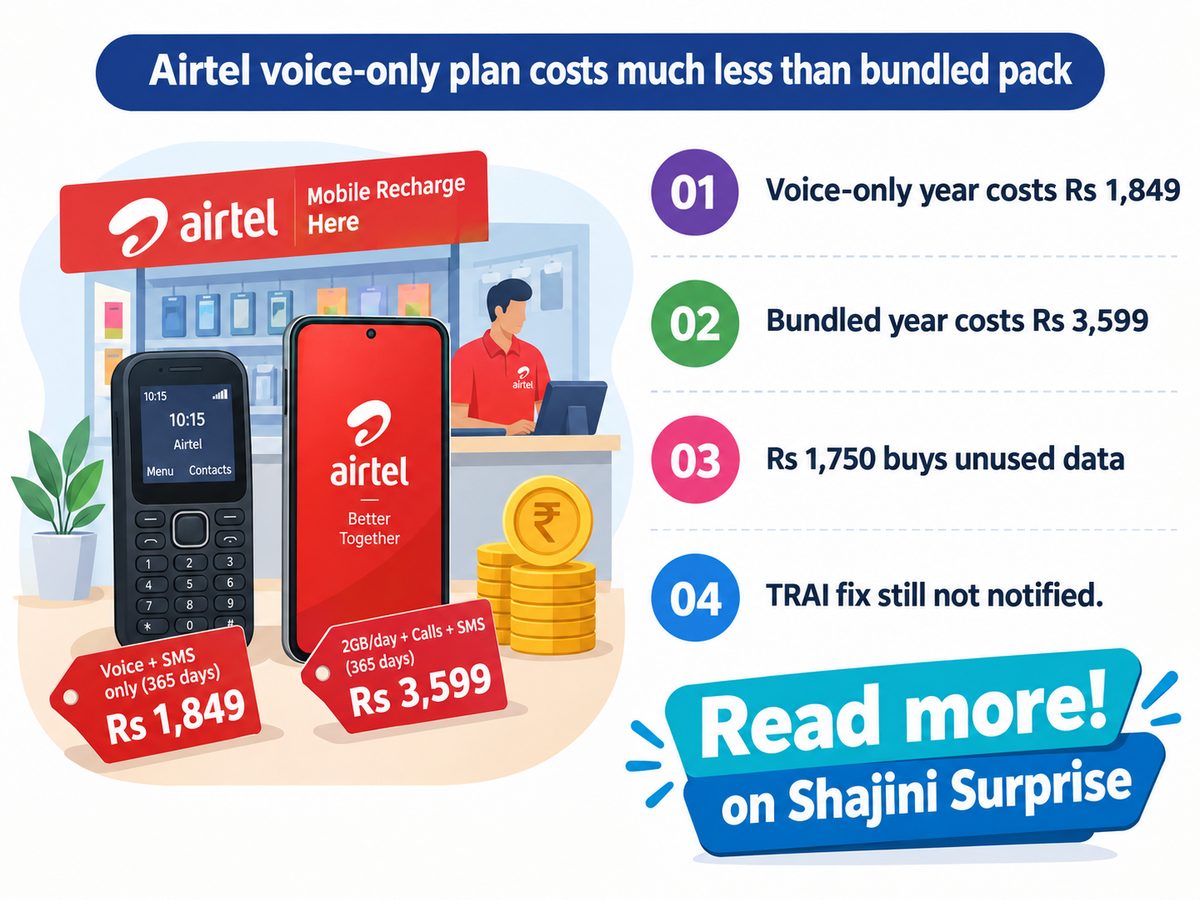
Airtel's voice and SMS voucher runs Rs 1,849 a year against Rs 3,599 for the equivalent bundled pack with 2GB of daily data, a gap of roughly Rs 1,750 on a line that would only ever take calls and forward the occasional OTP. Carry that second SIM in a basic handset or a dual-SIM slot, ask your employer to fund that specific line if a policy exists, and keep your primary personal number entirely out of the arrangement. That separation matters beyond the money: a work number on its own SIM can be handed back cleanly when you leave a job, while a personal number that quietly became the office contact line cannot be un-shared from years of client address books. If a policy does not exist yet, a concrete number like this, rather than a vague request for "phone reimbursement," is exactly the kind of specific ask that gets a policy written, the way a hard deadline changed behaviour where a soft guideline never did.
What A Voice-Only Line Will Not Fix
A voice-only second SIM does not help if your actual job needs the work number to run apps, receive attachments or stay reachable on chat, since none of that functions without a data connection of some kind.
It also does not resolve who owns the number if you leave the company, or what happens to years of client contacts saved against a line you paid for yourself. Ask what happens to the SIM, the number and every client who saved it, before you agree to anything. Put both questions to HR before you commit to any arrangement, personal SIM or company-issued, because a policy that only half answers the question tends to behave the way a rule that promises the whole amount while quietly holding a quarter back usually does.
Key Takeaways
- No Indian law forces reimbursement for a personal phone used at work; it runs entirely on your contract or HR policy.
- Company device, fixed allowance and unpaid bring-your-own are the three arrangements you will actually meet.
- A voice-only second SIM costs about Rs 1,750 less a year than a bundled data plan, if the job only needs calls.
- Settle who owns the number and the saved contacts before you agree to any arrangement, not after you leave.
So this week, work out which of the three arrangements you are actually in, put the real annual number in front of whoever sets policy, and if the job genuinely needs only calls and SMS, ask for that specific voice-only line rather than a vague monthly top-up. The gap between what a work phone should cost and what most people quietly absorb is bigger than a single recharge screen ever makes it look.
Related: work phone reimbursement
No comments:
Post a Comment
Note: Only a member of this blog may post a comment.