The offer letter says you will use your own mobile for official calls and that no reimbursement is payable. Whether that clause holds depends on where you sit. In California it runs into Labor Code 2802, which requires employers to cover necessary business costs. In India, the sources checked found no equivalent. Work phone reimbursement is a map with blank patches.
Your work address, not your employer's headquarters, decides whether your phone bill is owed.
- California requires a reasonable share of the bill, even on an unlimited plan.
- Illinois allows necessary costs inside a short window, and a written cap can limit them.
- In India a fixed BYOD stipend is taxed as salary, while a bill-backed claim is not.
- No Indian statute turned up in the sources checked, so negotiate in the offer letter.
Does work phone reimbursement depend on your state?
Yes: the United States has no federal statute on this, so your state decides, and California and Illinois, among others, require employers to cover necessary business costs, phones included.
California is the hard case for employers, or at least the costly one. As clockspot's July 2026 state guide summarises the statute, employers owe necessary business expenditures plus interest and attorney's fees, so an unpaid phone bill becomes a fee-shifting claim. Kelley Drye's December 2025 review says the 2014 Cochran v. Schwan's Home Service ruling (as of 2014) requires a reasonable share of the bill whether or not the plan was unlimited. "I would have paid for the plan anyway" is no defence. Sizing that share starts with your bill, as what unused data costs on a bundled recharge shows.
Illinois asks more of the employee. Its wage-payment law, per clockspot, covers necessary expenditures but sets a submission window and lets employers cap the amount in writing. As of 2024, Prokhorov v. IIK Transport holds that refusing submitted phone and internet costs may violate it, per Kelley Drye. Filed claims are enforceable; ones you never filed probably are not.
Federal law adds one narrow test: the Fair Labor Standards Act only bars unreimbursed costs that push pay below the minimum wage or overtime floor, so a well-paid employee has no federal claim. Montana, North Dakota, South Dakota and New Hampshire carry broad duties; New York and Pennsylvania apply only where the employer promised.
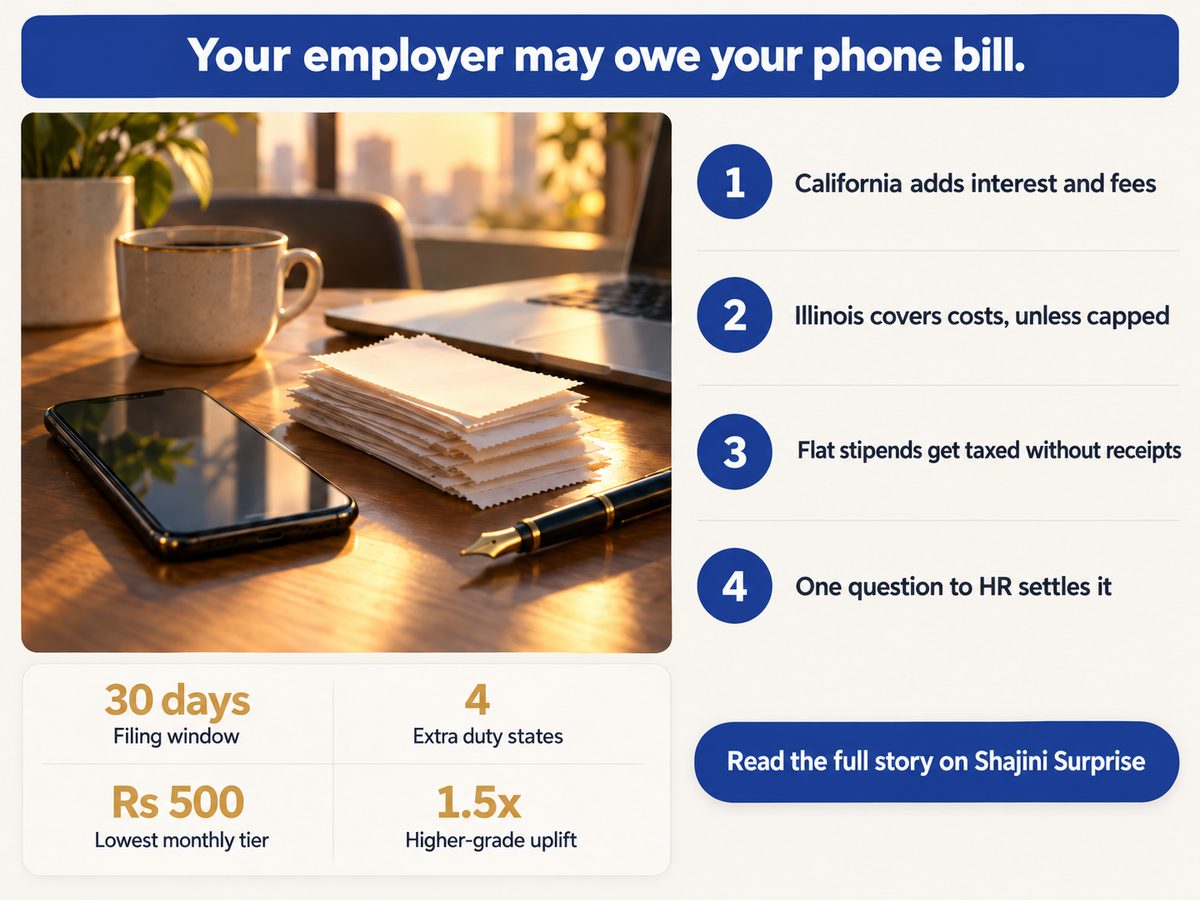
The clause sits beside terms like pro-rata gratuity for fixed-term IT staff. Four figures, from Kelley Drye, clockspot and Pluxee, decide the rest: filing time, broad-duty states, allowance size and grade uplift.
Illinois Claim Window
30 days
Late bills can be refused
Other Broad-Duty States
4 states
Your desk decides, not HQ
Lowest Flat Allowance
Rs 500 a month
Taxed without bills attached
Higher Tier Multiple
1.5x
Half again for higher grades
The window is the figure that catches people. Bills arrive monthly, so a skipped bill can be unclaimable by the time you ask. File every month.
The paper decides both fights: a late bill can be refused in Illinois, and an unbilled stipend is taxed in India.
Is a BYOD stipend taxable in India?
Yes: a fixed BYOD stipend is taxed as salary, while reimbursement against bills is not, in either tax regime, according to a March 2026 Pluxee benefits guide.
The guide cites Rule 3(7)(ix) for the tax-free route, a numbering that predates the Income-tax Act 2025, so confirm the current section with payroll. The same monthly sum is tax-free with bills attached and taxed without them, so the paperwork is the whole difference. Its examples come from one vendor's clients, so read them as illustrations, not a market rate.
Whether an Indian employer can make you fund work calls with no payment at all is unresolved in what I found. My view, and only a view, is that such a clause is a price to negotiate, not a rule to obey.
| Dimension | Bill-backed vs Flat | What it means for you |
|---|---|---|
| ⚖️ Tax rule | Bill-backed Non-taxable, both regimes Flat Taxed as salary |
❌ Part of each flat rupee goes to tax |
| 🧾 Proof kept | Bill-backed One bill, monthly Flat None asked |
⚠️ Skip the bill, lose the tax relief |
| 💰 Low flat tier | Bill-backed The actual bill Flat Rs 6,000 a year |
⚠️ Bills above this come from your pocket |
| 💰 High flat tier | Bill-backed The actual bill Flat Rs 9,000 a year |
⚠️ Your grade sets the tier, not your bill |
| 📊 Yearly gap | Bill-backed Follows your calls Flat Rs 3,000 between tiers |
⚠️ Ask for the higher tier in writing |
| 🏁 Best suited for | Bill-backed Heavy callers who keep bills Flat Light users, no paperwork |
🏁 Decide by how often you call |
Paper turns a taxed allowance into a tax-free one. The yearly figures are my arithmetic, twelve months of each tier. The map below covers whether you have a right at all.
In a duty state such as California or Illinois your phone bill is a claim you can file; elsewhere it is a negotiation to win in the offer letter. India's tile means none found in the sources checked, not none exists.
What can go wrong with a phone claim?
A claim is easiest to lose on paperwork, not principle: a late filing, a missing bill, a cap you signed without reading, or an exit where unpaid amounts never reach the final settlement.
The exit is where unclaimed costs disappear. India's 48-hour full and final settlement deadline now carries penalties, so list every pending phone claim in writing before your last day.
The usual advice is to take whatever stipend is offered because it is simpler. It is simpler for the employer. Take the flat sum only if you would never keep a bill.
- A written cap can lower the amount, so read the policy first.
- A chat promise is weak where the state applies only if the employer promised.
- A stipend with no bills is taxed, so take-home lands below the headline.
Key Takeaways to act on: tick any that describe you.
- Your desk is in a broad-duty state, whatever the head office says.
- Your payslip shows a fixed phone line and nobody asked for a bill.
- Your offer letter is silent on phone costs, or the promise was verbal.
- A cap sits in the policy and you have not reread it.
This week, put your offer letter and latest payslip side by side and email HR one question: is the phone line bill-backed reimbursement or a flat allowance? Then decide: if you call for work often, keep the bills and claim monthly; take the flat sum only if you never will.