Your manager asks you to take client calls on your own SIM card. The bill that month is ₹900, and HR offers a flat ₹500 "towards mobile". Who pays for work phone use in India depends less on the request than on how the money reaches you, and the tax difference is real.
Key Takeaways
Who pays matters less than how. A reimbursed bill can stay outside salary, while a flat phone amount is taxed as pay.
- A fixed phone stipend with no bills is added to salary and taxed.
- A bill-backed claim is exempt only up to the lower of the bill or the amount offered, so any surplus is salary.
- Usually one connection in your name, so family plans fall outside.
- Section 2(y) of the Code on Wages can pull a large phone allowance back into wages.
Who Pays for Work Phone Use, and Why the Bill Matters
None of the sources we checked says whether a law requires an employer to pay for a work phone, but if yours does pay, the tax result turns on whether it reimburses your bill or pays a flat amount.
Rule 3(7)(ix) of the Income-tax Rules, 1962 values most other perks at arm's-length cost to the employer, but its proviso takes telephone expenses, mobile phones included, that the employer actually incurs on your behalf out of that method. Pluxee's 2026 guide and ClearTax both read the proviso as an exemption when bills back the claim. For you, a bill your employer pays is not valued as a perk.
The flat route is harder to defend. Pluxee's guide says a fixed monthly stipend with no bills is added to salary and taxed, and a BYOD stipend is taxable unless an invoice backs it. That means you pay for the phone out of money already taxed as salary, with no bill to show for the work use. Our post on the wage rule's one-half test explains the threshold, and which US states make employers pay for a personal phone used at work shows how another country handles it.
Four numbers decide most of this, and each traces to a named source. Pluxee's guide, dated 13 March 2026, reproduces one firm's HR table, ₹750 a month at grades 5 to 7. ClearTax, undated and retrieved 21 October 2026, supplies the one-connection condition. A 2007 notification put the phone-expense proviso into force from 1 April 2008, and section 2(y) of the Code on Wages, 2019 sets the one-half test.
Years in Force
18 years
The rule a bill claim rests on
Monthly Flat Amount
₹750 a month
One firm's flat amount, grades 5 to 7
Connections Covered
1 line
Usually the only exempt connection
One-Half Test
50%
Above half of pay, excess counts as wages
Section 2(y) asks one question: is a payment a genuine cost of the job, or pay under another name? Clause (e) excludes sums that defray special expenses of the employment, but the one-half test still counts those sums, and any excess goes back into wages. Past that point, a phone allowance is salary by another route.
A flat phone amount is salary, whatever HR calls it. A bill is a receipt, and the exemption rests on receipts.
Bill Claim or Flat Stipend: How They Differ
A bill claim and a flat stipend differ on four points: tax, amount, proof and whose line counts, and each row below takes one of them.
Read each row against the offer you have. The middle column gives both routes, and the right column says what it means for your pay.
| What differs | Bill claim vs stipend | For you |
|---|---|---|
| 💰 Tax | Bill claim Not taxed as pay Stipend Taxed as salary | ✅ Keeps phone money out of pay |
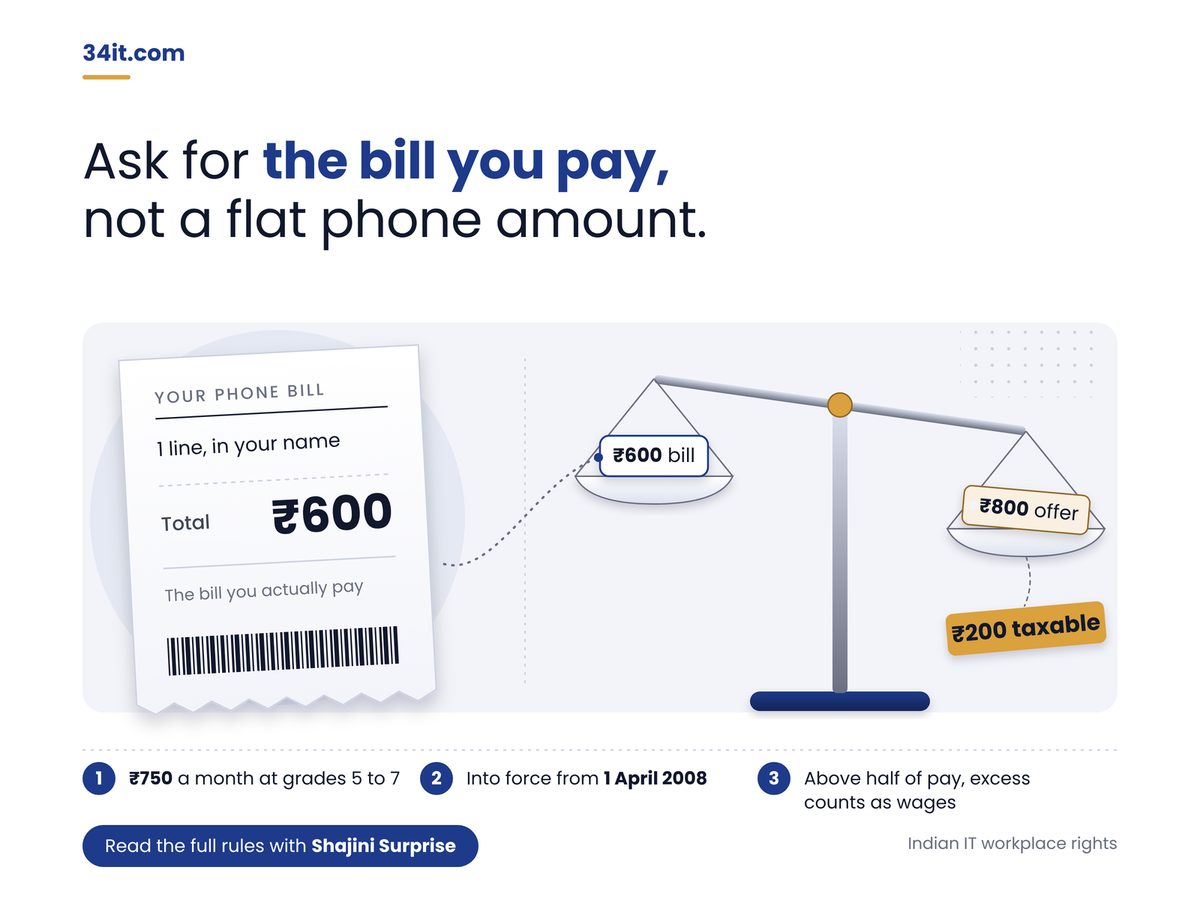
| 📊 Amount | Bill claim Lower of bill or offer Stipend Fixed sum | ⚠️ ₹600 bill, ₹800 offer: ₹200 taxable |
| 🧾 Proof | Bill claim 1 bill a month Stipend No bill | ❌ No bill, no exemption |
| 🔒 Line | Bill claim 1 line, in your name Stipend Fixed sum | ⚠️ Family plans usually fall outside |
| 🏁 Best suited | Bill claim Firms that reimburse bills | 🏁 Anyone keeping monthly bills |
Take last month's phone bill and the amount your employer offers, and put the two side by side. The exemption follows the smaller figure, so anything the offer adds above your bill is salary. Then check the proof: is the line in your name, and does the bill show your number? Those two answers tell you which column you are in.
💰
Bill claim
Lower of bill or offer
💸
Flat stipend
Taxed as salary
🧾
Bill in your name
The proof you need
🔒
One line
Usually all that is covered
Ask for the bill, not a flat phone amount, because bill-backed claims can stay outside salary and flat stipends cannot. Source: Pluxee's 2026 guide and ClearTax, both summarising Rule 3(7)(ix).
Where Phone Claims Go Wrong
A phone claim can fail on paperwork rather than on the rule, because the bill may sit in someone else's name or cover a family plan. Check both before you ask for reimbursement.
The connection rule is the one to check first. ClearTax describes the exemption as covering usually one connection, in the employee's name, with a bill shown and business use. A family plan or a second SIM sits outside that, even if you use it for work calls. If you use a voice-only recharge, read how a voice-only recharge changes your bill.
Watch the amount too. Pluxee reproduces one firm's HR table, and a flat sum like that is the kind that gets taxed unless a bill backs it. My read, not a sourced finding, is that whether an employer can insist you use your own phone is still an open question, so get the policy in writing rather than rely on a verbal promise.
- Your employer calls a flat amount a "phone bill".
- Your claim covers a family plan.
- Your bill is in a colleague's name.
- Your phone has no record of work use.
Key Takeaways to act on
- Your line is in your name and is not a family plan.
- Your bill shows your name and your number.
- Your work calls and messages run on that same number.
- Your offer is a bill claim, or HR agrees to make it one.
Ask for the bill you actually pay, not a flat phone amount, because a bill-backed claim is the route the exemption covers. So the decision in front of you is a bill claim or a flat stipend, and the bill wins on tax. Ask HR this week to reimburse the bill in writing, and ask for the policy before you accept any allowance.
No comments:
Post a Comment
Note: Only a member of this blog may post a comment.