Section 32 of the Occupational Safety, Health and Working Conditions Code, 2020, in force since November 2025, lets a worker carry no more than 30 days of annual leave into the next calendar year. Day 31 is not forfeited. Under the new leave encashment rules, the excess can be paid out in cash when the year closes, but the clause puts the burden on you: the money follows a request, not the calendar.
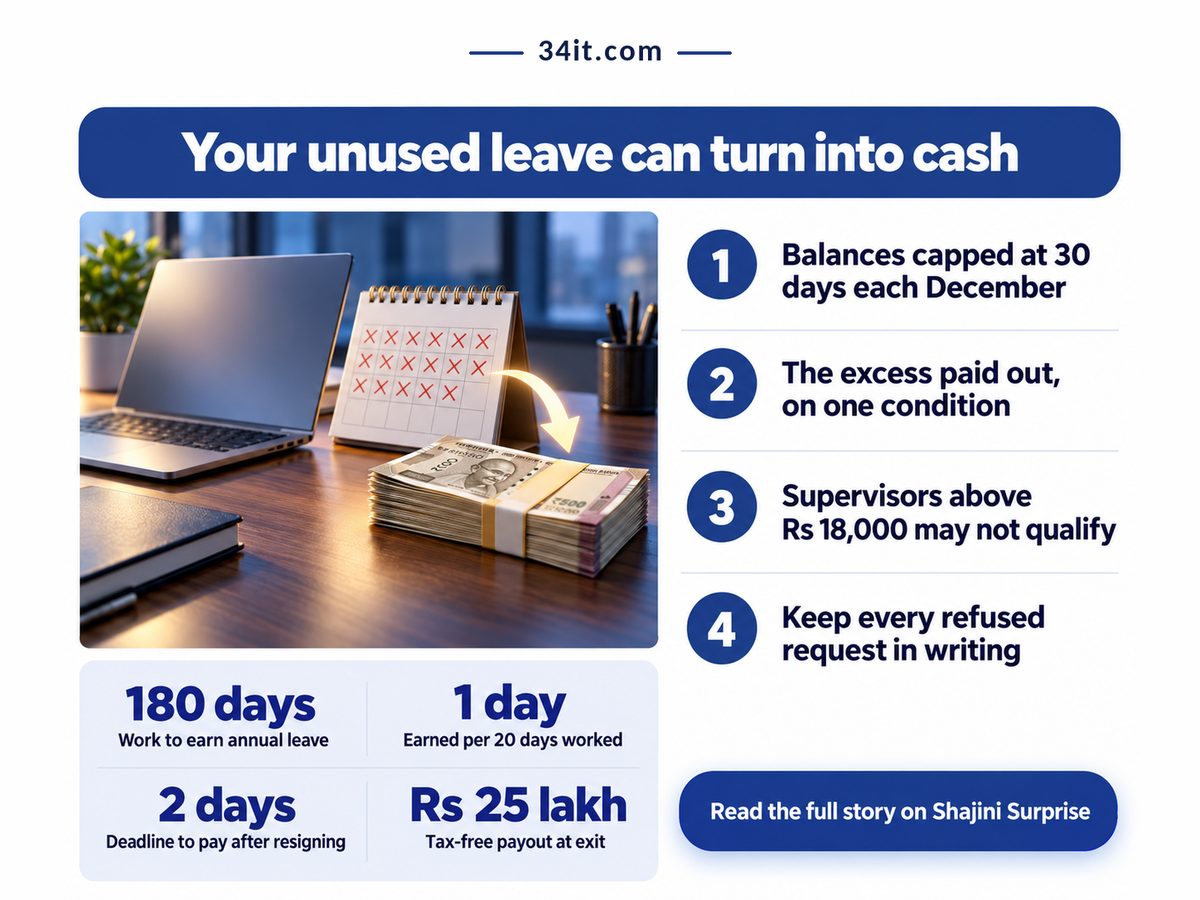
Key Takeaways: leave above the carry-forward cap does not vanish: a worker can ask for it to be paid in cash when the calendar year ends.
- Leave you applied for and were refused carries forward with no ceiling, so keep the rejection email.
- Joiners after roughly the end of April cannot qualify this calendar year, yet accrued leave is still paid at exit.
- Year-end encashment is taxed as salary, while exit payouts sit inside a large exemption.
How many earned leaves can be carried forward under the new labour code?
A worker can carry forward up to 30 days of annual leave into the next calendar year, and any leave that was applied for and refused rides on top of that cap with no limit at all.
That second half is the clause worth printing. JSA Law's April 2026 analysis of section 32 reads it plainly: refused leave escapes the cap, and the balance above the cap is encashable on demand at year end. A manager who rejects your December leave has moved those days outside the ceiling. Keep that email; it proves the days were refused, not simply untaken.
The cap itself is the least interesting part of the rule. What is new for IT staff is a national floor no policy can undercut, and a payout trigger the employee controls.
It sits beside the pro-rata gratuity rule for fixed-term IT staff and the 50% wage rule that cut take-home pay, and shares their weakness: each protects only the people the Code calls workers. Four numbers decide whether you have leave to encash at all. Outlook Money (25 March 2026) and People Matters (14 April 2026) report the threshold, accrual rate and wage line; the annual floor is this article's arithmetic over a full working year.
Days Worked to Qualify
180 days
About two months sooner than before
Accrual Rate
1 per 20
Policies may beat it, never undercut
Annual Leave Floor
About 12 days
Your offer letter can only exceed it
Supervisor Wage Line
₹18,000/month
Above it, you may be out
The accrual rate is the one to check against your offer letter. Most IT policies already beat it, which is fine: the Code sets a floor, not a ceiling. It bites for the employee on a lean contract, whose policy cannot quietly drop below it.
A supervisor paid above the wage line may sit outside section 32 entirely. Your duties, not your designation, decide whether any of this protects you.
Leave encashment rules at a glance
The rules split into two payouts: a year-end encashment of leave above the cap, paid only when a worker asks, and an exit payout of the whole balance, owed on any exit whatever the tenure.
Exit timings come from Simpliance's section 32 summary (undated, retrieved 16 October 2026, not the Gazette text); the tax line is the CBDT's 2023 change to section 10(10AA). The joiner cut-off is this article's own reasoning: at five days a week the eligibility threshold takes about 36 weeks of work, so a joiner after roughly the end of April cannot reach it by 31 December.
| Category | Detail | What it means |
|---|---|---|
| 💰 Year-end cash | Days above the 30-day cap, on written request | ⚠️ Taxed as salary in that year |
| 🧾 Exit tax | Exempt up to ₹25 lakh, non-government staff | ✅ Most exit payouts land tax-free |
| ⏱ Exit payout | Before the 2nd working day after you leave | ✅ Chase it with the F&F, not later |
| 📊 Short tenure | Accrued days paid even below the threshold | ✅ A six-month leaver is still owed |
| ⚖️ Refused leave | Carried forward with no upper limit | ✅ A rejection email beats the ceiling |
| ⏱ Joiner cut-off | Start work after about 1 May | ❌ Nothing to take until next January |
The exit payout protects you automatically; the year-end payout protects you only if you act. One caveat: excess days cashed in December are taxed at your slab, whereas the same days paid at exit would fall inside the exemption. Unclaimed days may lapse under company policy, so ask anyway.
If your balance will pass the cap on 31 December, a written encashment request is the only way to keep the extra days' value; refused leave carries over regardless. Worked example derived from section 32 as analysed by JSA Law (April 2026); the 42-day balance is illustrative.
Does the new labour code apply to IT employees?
It applies to IT employees who qualify as workers, which typically covers individual contributors, but managerial and administrative staff, and supervisors earning above the wage line, fall outside the leave protections in section 32.
Titles in IT are inflated, so ignore yours. A lead with no reports may still be a worker; an associate manager who signs off appraisals may not be. Check your job description for supervisory duties.
Outlook Money and People Matters both report that several states have not notified final rules; where yours has not, its Shops and Establishments Act still sets your leave terms. Whether a policy that lapses leave above the cap survives for workers is, in my view, the open question. My reading is that it should not, since a lapse clause and an encash-on-demand clause cannot both be honoured (at least not until a labour court says which wins).
On exit, the leave payout runs on the same clock as India's 48-hour full and final settlement deadline, so a month-long settlement cycle is late on this line item too. Watch for these:
- A policy line saying leave above the cap lapses on 31 December.
- A refused leave request that exists only as a verbal no.
- A settlement statement that leaves out leave wages for a short-tenure exit.
Check these before 31 December
- Nobody reports to you, or your pay sits below the supervisor wage line.
- Your balance on the last working day of December will exceed the carry-forward cap.
- At least one refused leave request is saved as an email or HR-system record.
- Your state labour department lists its OSH Code rules as notified.
Tick the first two and the payout is yours to claim.
The decision is whether to ask, and for any worker heading past the cap the answer is yes. This week, check your balance against the ceiling, save every refused-leave email to a folder you control, and send HR a two-line written request to encash the excess on 31 December.
No comments:
Post a Comment
Note: Only a member of this blog may post a comment.