The clause usually sits a few pages into the offer letter, under a heading like Service Agreement: leave before a fixed term ends and you pay a stated sum as liquidated damages for training. Freshers at Indian IT services firms sign it on joining day. That employment bond is enforceable more often than office WhatsApp groups claim, but the printed number is where your employer's case starts, not where it ends.
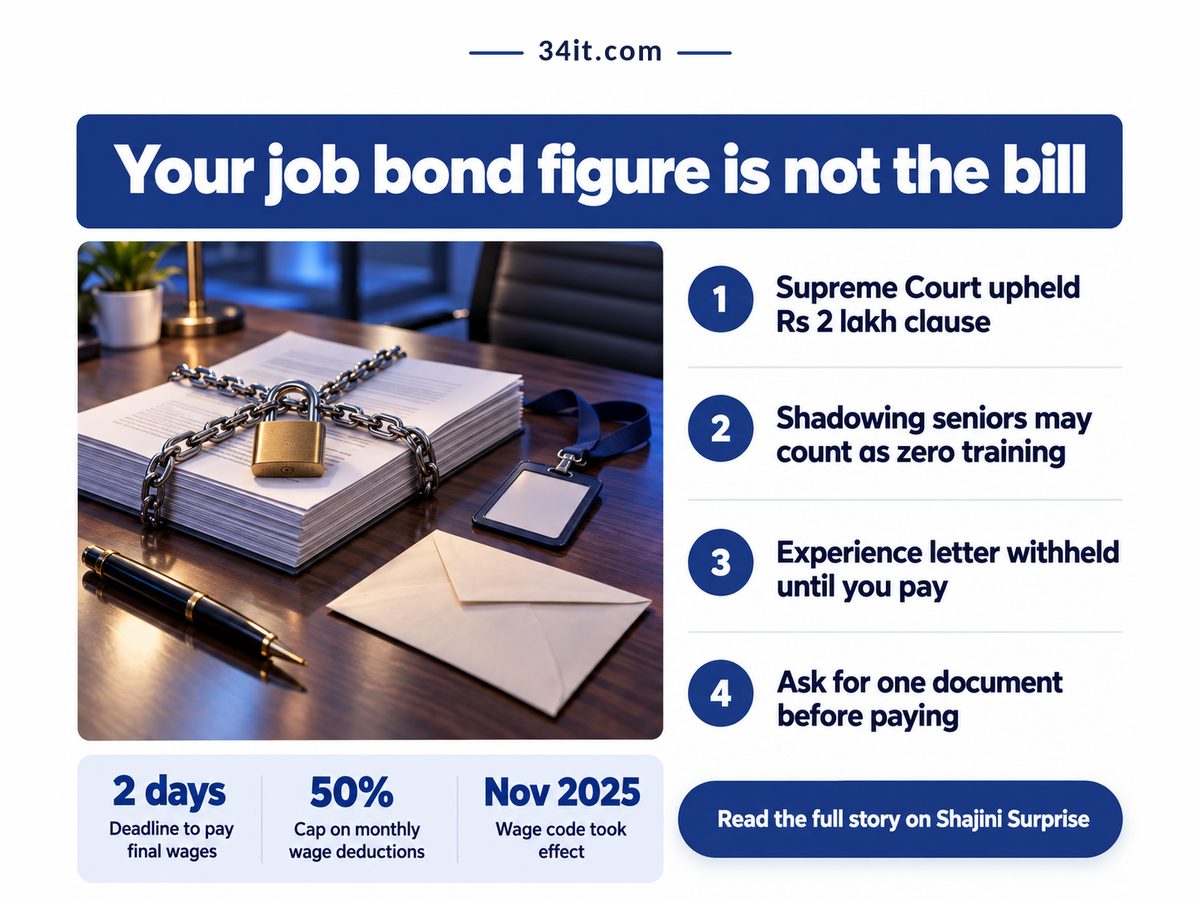
A bond can be enforced, but only for training cost your employer can prove, reduced for the time you served, and never by cutting it from your final salary.
- The Supreme Court upheld a bank's bond clause in May 2025, so calling every bond void no longer works.
- The stated sum is a ceiling; courts cut damages for months served and thin training.
- Training recovery is not a permitted wage deduction, so it cannot come out of your full and final settlement.
- Before paying anything, ask HR in writing for the itemised training-cost record.
Is an employment bond legal in India now?
Yes, a bond that ties you to a minimum service period is generally enforceable in India after the Supreme Court's 2025 ruling, but only for loss the employer can show and in proportion to your pay.
The case is Vijaya Bank v Prashant B. Narnaware, decided by the Supreme Court on 14 May 2025. An officer agreed to serve three years or pay ₹2 lakh, then left early. The Court held that a covenant operating during employment is not a restraint of trade under section 27 of the Contract Act. Quoting section 27 at HR no longer ends the conversation; the fight is now over amount and proof.
The win is narrower than it looks. According to Bharucha & Partners' note on where bonds stand now, the sum was held non-penal because the bank bore real recruitment cost and the officer was a senior middle manager who could pay. My reading is that the ruling quietly helps freshers, since proportionality to pay is now part of the test.
It also binds less than it seems. Vijaya Bank is a public sector bank, so for a private IT firm the judgment is persuasive, not binding, as one May 2025 post-ruling analysis notes. Tenure also moves your gratuity under the 2026 rules too. If the company is easing you out, through silent layoff signals tech workers miss, keep every email: in my view that weakens its claim to damages.
Four numbers decide what you hand over. Two come from the Code on Wages, 2019, in force since 21 November 2025. Two earlier rulings Bharucha cites, Ledalla Ravichandar v Satyam and Sicpa India v Manas Pratim Deb, cut damages for time served and pay scale. Saurabh Seth, in Bar & Bench on 24 January 2026, valued on-the-job training; that is practitioner opinion, not a ruling.
Deadline for Final Wages
2 working days
Pay cannot wait on disputes
Recoverable Cost of Shadowing
₹0
If KT was your training
Rulings Cutting Bond Damages
2
Time served lowers the bill
Cap on Deductions per Wage Period
50%
Half your pay stays protected
Take the deadline: under section 17(2), HR cannot park your last salary during a bond dispute. Section 18 lists every permitted deduction, from fines and advances to tax and court orders, and training recovery is not on it. The lawful route is a civil suit.
A bond is a claim your employer has to prove in court, not a line it gets to subtract from your last payslip.
So what does a court actually allow when you leave early?
What happens if you break a training bond?
If you leave before the bond period ends, your employer can claim damages, but courts tend to cut the stated sum to proven training cost, reduce it for months served, and the claim has to go through a suit.
In the middle column, the first line is the bond and the second is what courts and the Code have allowed.
| Dimension | Bond vs court | What it means for you |
|---|---|---|
| 💰 Amount owed | Bond full sum, any exit date Court proven loss, s.74 ceiling |
✅ The printed figure is a maximum, not a bill |
| ⏱ Time served | Bond same sum at any month Court month 30 of 36, a sixth left |
✅ Each month you stay shrinks the claim |
| 🛠 Training proof | Bond training left undefined Court invoices, dates, trainers |
⚠️ Thin paperwork weakens their case |
| 📊 Pay scale | Bond one sum for every grade Court 2025 test weighs your pay |
⚠️ Freshers hold the stronger fairness case |
| 🧾 Final pay | Bond netted from your F&F Court s.18 list has no bond line |
✅ Your last salary arrives untouched |
| ⚖️ Exit papers | Bond letter held till paid Court no lien on documents |
✅ Refuse the swap and keep it in email |
| 🔒 Notice gap | Bond rolled into the bond sum Court unserved days' pay only |
❌ You still owe this, as a separate sum |
| 🏁 Best suited for | Pay classroom spend proven Contest training was only shadowing |
🏁 Ask for the record before deciding |
Five of eight rows favour you or turn on paperwork the employer controls. Classroom training with invoices is a real claim; shadowing mostly is not.
Leaving at month 24 of a three-year, ₹2 lakh bond puts at most about ₹66,667 at risk, less if receipts are thin. That is our own pro-rata arithmetic on the Vijaya Bank terms, not a court's figure.
Can HR hold back your experience letter or final pay?
No, withholding your experience letter until you pay the bond is pressure rather than a legal remedy, and your final wages fall due on time whatever the bond dispute, so put every demand in writing.
Seth calls trading a bond payment for an experience letter illegal leverage. It still works more often than it should (a missing letter stalls the next background check). Specific performance of a service contract is barred, so the most a bond becomes is a money claim.
Notice is separate. Skip part of it and, on Seth's reading, you owe at most salary for the unserved days, never bundled into the bond figure. Check the payment date against the 48-hour full and final settlement deadline, and watch for:
- A bond letter with one lump sum and no cost breakdown.
- A training recovery line on the F&F statement, a separate issue from the wage-definition rule that reshaped take-home pay.
- Notice pay and bond damages merged into one figure you are asked to sign.
Key Takeaways to act on: check these before you pay
- Your offer letter names a training cost, not only a penalty.
- HR can show invoices or trainer records for your batch.
- Your training was a formal programme, not shadowing.
- Less than a sixth of the bond term is left to run.
Two or more false: contest rather than pay.
The decision is whether to pay or contest, and it turns on one document. This week, email HR for the itemised training-cost record behind your bond and state that you expect your final wages in full. If the record exists, offer your unserved share of the proven cost. If it doesn't, decline and let the company decide whether a suit is worth it.
No comments:
Post a Comment
Note: Only a member of this blog may post a comment.