Section 2(y) of the Code on Wages, 2019 defines wages as basic pay, dearness allowance and retaining allowance. HRA, conveyance and the rest of the payslip sit outside that definition, but only up to a point: once those exclusions pass half of total remuneration, the excess is added back and treated as wages. That add-back is the 50% wage rule. The Code commenced on 21 November 2025 and its central rules were notified on 8 May 2026, according to a 13 August 2026 analysis by law firm KS&K, so a salary restructure in this year's revision letter is compliance, not a favour.
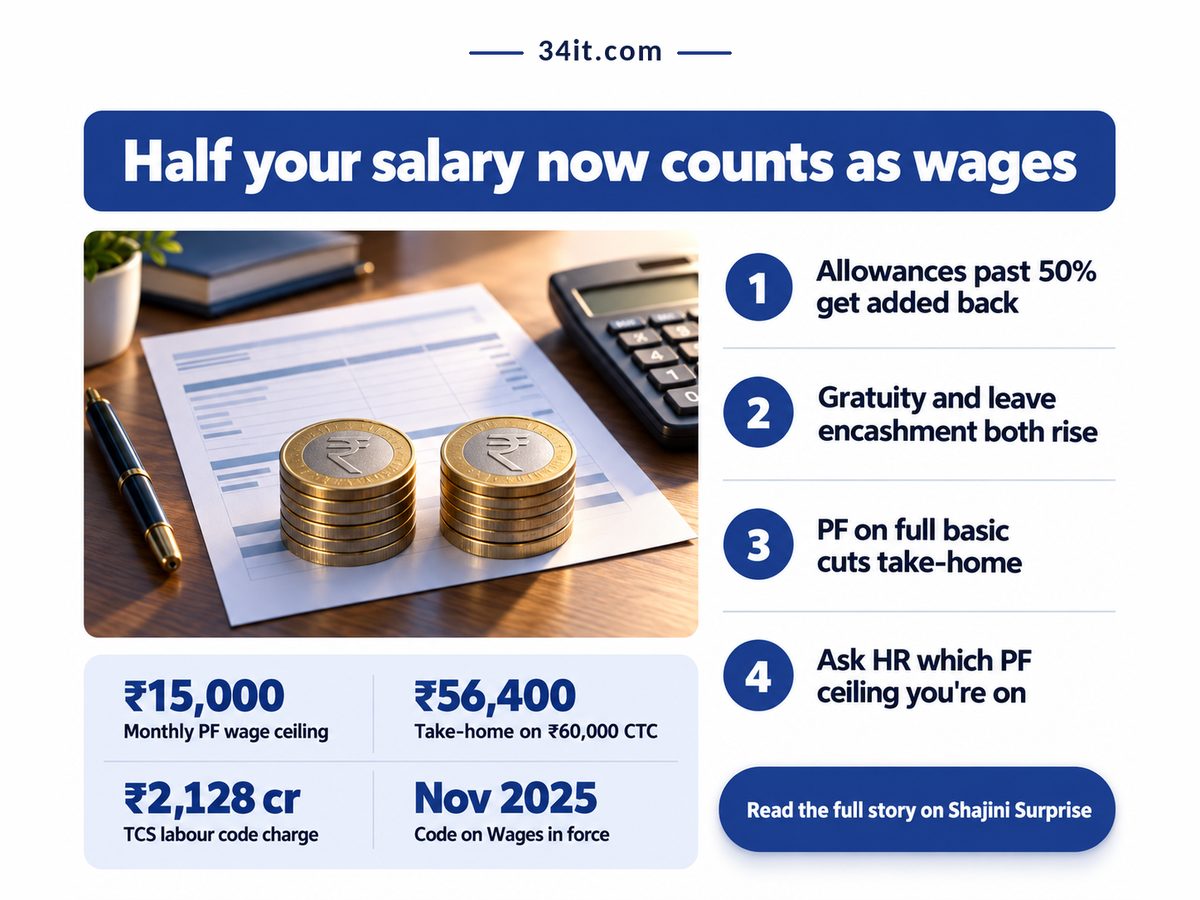
Take-home falls only if provident fund is calculated on full wages instead of the statutory ceiling; gratuity and leave encashment rise either way.
- Allowances above half of total pay are deemed wages, even if the payslip never relabels them.
- PF deducted on the ceiling leaves take-home unchanged, and anything above it is voluntary.
- On a ₹60,000 monthly CTC, PF on full wages takes ₹3,600 more out of your hand each month.
How the 50% wage rule counts your pay
The rule adds up everything Section 2(y) excludes from wages, compares that total with half of your total remuneration, and counts any excess back as wages, the base on which gratuity and leave encashment are computed.
The exclusions are listed. KS&K's reading of the Code names HRA, conveyance, employer contributions to PF and pension, gratuity, performance incentives and overtime. Add those lines on your payslip and divide by total pay. Under half, nothing moves. Over half, the gap crosses into wages. For contract staff the same base now feeds pro-rata gratuity after one year of fixed-term service.
Employers ran this arithmetic months ago. A 21 January 2026 tally by CA Rajput of Q3 FY26 company disclosures lists one-time labour-code charges at the largest Indian IT services firms, booked because a bigger wage base means a bigger gratuity and leave-encashment liability on service already worked. I think the payslip is the wrong end of the story: the larger change sits in what you are owed when you leave, and the four figures below decide whether you should expect it.
Time the Code Has Applied
10 months
Your next revision is in scope
TCS One-Time Charge
₹2,128 crore
Higher gratuity already funded
IT Majors Booking a Charge
6 firms
Your employer likely did too
Exclusions Allowed Before Add-Back
50% of pay
Beyond it, allowances become wages
A provision is money set aside for gratuity and leave encashment the company now accepts it owes on years you have already worked. If your employer booked one, the higher payout is sitting in its accounts. Check your exit payout for it before you sign a full and final settlement under the 48-hour deadline.
Six of India's largest IT employers have already paid for your higher gratuity. Whether your exit cheque shows it is the only question left.
Will take-home salary reduce under the new labour codes?
Take-home falls only if your provident fund is calculated on the full wage figure; the Labour Ministry said on 10 December 2025 that PF deducted on the ₹15,000 ceiling leaves take-home unchanged.
The Ministry went further: contribution above the ceiling is voluntary. OutlookMoney's 13 December 2025 report on that clarification works one salary through, a ₹60,000 monthly CTC made up of ₹20,000 in wages and ₹40,000 in allowances. Allowances there are two-thirds of pay, so ₹10,000 of them is added back and the Code's wage figure becomes ₹30,000. That last step is my arithmetic, not the report's. The table runs both PF choices on that salary, employer share inside the CTC, as the report's own take-home figure implies.
| Dimension | Ceiling vs full wages | What it means for you |
|---|---|---|
| 💰 Take-home | Ceiling ₹56,400 a month Full wages ₹52,800 a month |
⚠️ Full-wage PF costs ₹43,200 a year in hand |
| 🧾 PF wage ceiling | Ceiling 12% of ₹15,000 Full wages 12% of ₹30,000 |
⚠️ Every rupee above the cap is a choice |
| 🔒 Locked savings | Ceiling ₹3,600 a month Full wages ₹7,200 a month |
✅ Retirement money builds twice as fast |
| 📊 Gratuity base | Ceiling ₹30,000 in wages Full wages ₹30,000 in wages |
✅ Exit payout rises whichever PF you pick |
| ⚖️ Legal footing | Ceiling Ministry-backed default Full wages voluntary extra |
✅ Grounds to query a full-wage deduction |
| 🏁 Best suited for | Ceiling rent or an EMI due monthly Full wages money you won't touch for years |
🏁 Choose by when you need the cash |
The monthly gap does not vanish; it moves into a locked account, and half of it is your employer's share. Whether that counts as a loss depends on your rent and EMIs, not on the law. What the law settles is that you should be asked. Gratuity rises either way: it follows the Code's wage figure, not your PF election.
If your allowances add up to more than half of your CTC, the slice above that half now counts as wages, so work out that one number before you read any revision letter. Derived by applying the Section 2(y) add-back to OutlookMoney's ₹60,000 worked example.
Is 50% basic salary mandatory under the new wage code?
No, the Code on Wages does not require basic pay to be exactly half of CTC; it requires excluded allowances above half of total remuneration to be counted as wages, whatever the payslip calls them.
KS&K makes the point directly: the rule does not oblige an employer to designate exactly half of CTC as basic. So when a revision letter says the law forced basic up, it overstates the law. That is worth raising, because a higher printed basic can drag PF up with it while the add-back alone would not.
The ceiling itself is not moving soon. People Matters reported on 3 December 2025 that the government made no commitment to raise the EPF wage ceiling to ₹30,000, saying any change needs extensive stakeholder consultation. Money pushed into PF is also harder to take out than it looks, as the EPF withdrawal rules and the 25% balance lock show. The grey area, and this is opinion, is whether firms that booked a gratuity charge quietly recover it through slimmer increments, and the place to watch is the special allowance line, year on year.
- A revision raising basic and cutting special allowance equally: CTC flat, PF on a bigger base.
- A PF deduction worked on a figure above the ceiling, with no written option offered to you.
- An exit settlement that computes gratuity on the old basic alone, ignoring the added-back slice.
Key Takeaways to act on
- Your HRA, conveyance, incentives and special allowance together exceed half of your monthly pay.
- Your PF line divided by 12% gives a number larger than the statutory cap.
- Nobody has asked you, in writing, whether you want PF above the cap.
- Your employer disclosed a labour-code charge in its quarterly results.
The decision is narrow: PF at the ceiling or PF on full wages, and the law leaves it open. If two or more of those conditions are true, email payroll this week and ask, in writing, which wage figure your PF uses and whether contribution above the ceiling was your choice. Get the answer before the next revision letter, not after it.
No comments:
Post a Comment
Note: Only a member of this blog may post a comment.