The email lands on a Friday. Your role is redundant, your last working day is the thirty-first, and HR attaches a settlement sheet you will read four times without really reading it. Somewhere in that afternoon you open the EPFO portal. Years of contributions sitting there, yours, and every headline you have seen this summer says you can now withdraw the whole thing.
You can't. Not the whole thing, and not soon.
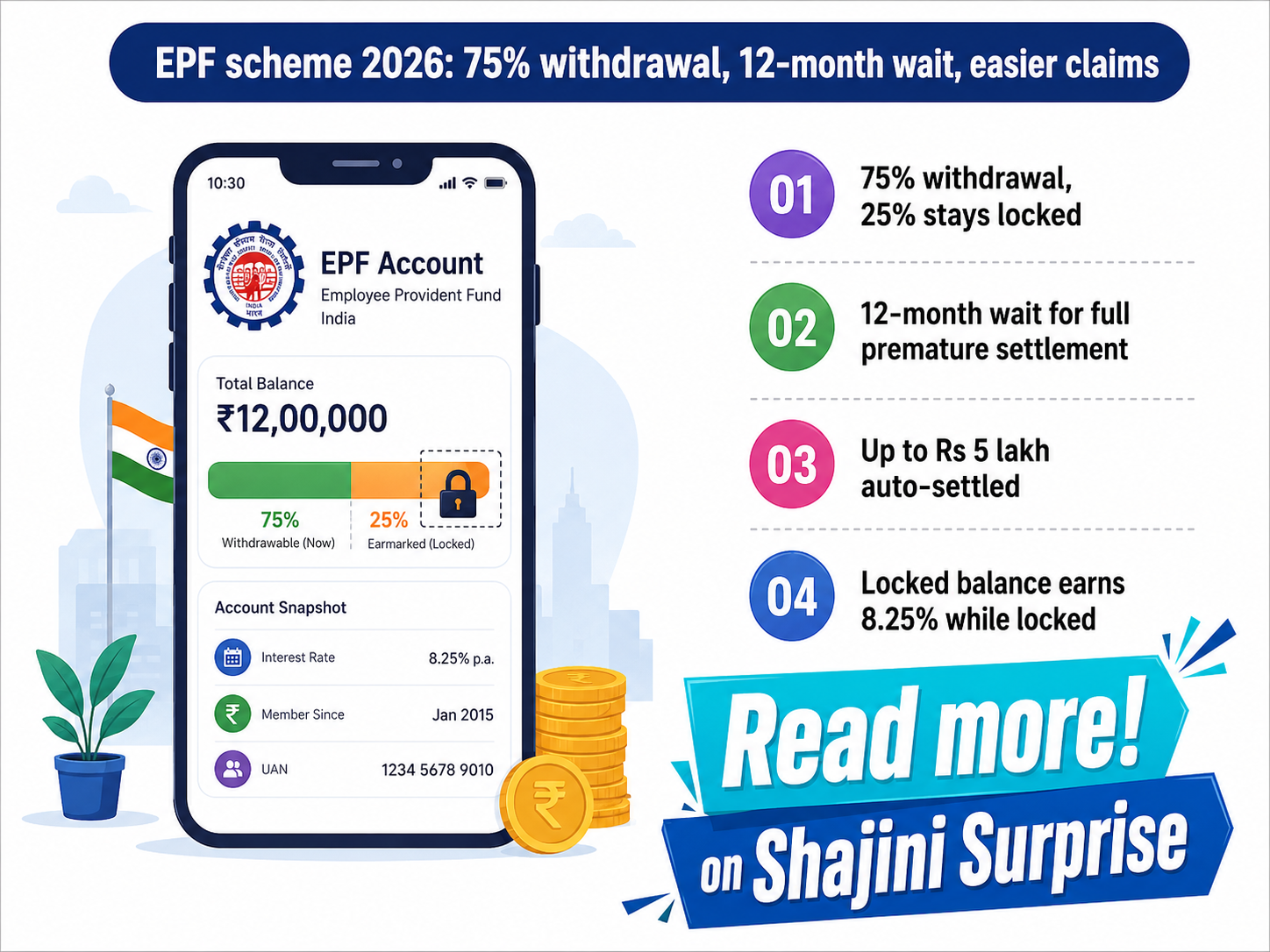
TL;DR: The EPF Scheme 2026 does let you claim 100% of your eligible balance. But a quarter of the account is earmarked and stays put, so the real ceiling is 75%. And the wait for a full premature settlement after leaving a job moved from two months to twelve.
Why The Withdrawal Headline Got It Backwards
The coverage was not wrong. It was incomplete in exactly the place that decides whether you make rent. "Withdraw up to 100%" is a real phrase from a real government release, and it refers to 100% of the eligible balance. Eligible balance is what remains after the scheme earmarks 25% of your contributions as a minimum balance you cannot touch while the account stays open. Do that subtraction and the number on the screen stops being a hundred and becomes seventy-five.
And the framing matters more than usual here, because the people who most need the money are the ones reading fastest. Anyone who has just been through a restructuring knows the mental state. You are scanning for a number, not for a qualifier. If you budgeted your notice period around the full balance and the portal releases three quarters of it, that gap is not an accounting curiosity. It's a month of expenses.
Then there's the part almost nobody led with. The Ministry of Labour and Employment's 13 October 2025 release put the waiting period for a premature final settlement at twelve months, up from two. Read that against what actually happens when a job ends in India. The 48-hour full and final settlement deadline now forces your employer to clear dues fast, which is genuine progress, but employer dues and your own provident fund are two different taps. One got faster. The other got a ten-month longer queue. If your exit was one of the quiet layoff patterns most people miss, where the paperwork says resignation and the reality says otherwise, you are in that queue with no severance argument to make.
Wait for full premature settlement
12 months
Previously two months
Auto-settled claim ceiling
Rs 5 lakh
Cleared without documents
EPFO corpus under management
Rs 28 lakh crore
Members' money, not government money
Interest on the retained balance
8.25%
Compounded while locked
The auto-settlement ceiling is the one worth sitting with, because it is doing quiet work. A claim under that limit clears without a human reading your file and without you uploading anything, which is why settlement times have collapsed for ordinary members. Above it, you re-enter the old world of verification, queries and a regional office. Most salaried members with a decade of service will cross that line at some point, and nothing in the new scheme changes what happens on the other side of it.
Two months became twelve. For anyone out of work, that single line decides whether the provident fund is an emergency cushion or a retirement statement they can only look at.
What The EPF Scheme 2026 Actually Changed
Strip the announcements down to what a member experiences at the portal and the changes sort into seven items. Some of them are real improvements. Two of them are the ones you will feel.
| Category | Detail | Insight |
|---|---|---|
| Minimum balance | 25% of the eligible balance is earmarked and stays in the account | A quarter never leaves the account |
| Real ceiling | Three quarters of the account is the true maximum you can pull | Hundred percent means three quarters |
| In force from | The EPF Scheme, 2026 took effect on 29 June 2026 | Already live, not a future proposal |
| Pension exit | The EPS withdrawal benefit now carries a 36-month wait | Three years before pension money moves |
| Categories | Housing, essential needs, and special circumstances replace the old list | Thirteen old provisions folded into three |
| No-reason route | Twice a year under special circumstances, no justification required | Two free passes, no questions asked |
| Confirmed in | A Lok Sabha reply on 10 August 2026 restated the new waiting periods | Stated on the floor this month |
Read as a whole, the scheme is a trade. Speed and simplicity on the way in, friction on the way out. Thirteen fiddly provisions collapsing into three plain categories is a genuine win, and the twice-yearly no-questions route is more flexibility than members have ever had for a small emergency. The bill for all of that is paid by the person whose emergency is not small.
The bar is drawn to scale: the shorter block on the right is the portion of your own account that stays where it is, no matter which category you claim under.
Where This Quietly Costs You
Policy arguments for the lock are easy to make, and some of them are good. Provident fund balances in India get emptied at the first job change and rebuilt from zero, which is how people reach fifty with a corpus that looks like it belongs to a thirty-year-old. Forcing a floor under the account interrupts that habit. Fine. I agree with the goal.
Whether it works is a different question, and this is where I think the confident takes on both sides are running ahead of the evidence. Nobody has published the counterfactual: how many members, blocked from their own savings during a bad stretch, ended up on a personal loan or a credit card at rates no provident fund has ever paid. I have a hunch about which way that number falls. I don't have the data, and honestly, neither does anyone arguing the opposite. Treat anyone who sounds certain about it as someone with a position rather than a finding.
What is not in doubt is who absorbs the friction. Someone with a working spouse and six months of runway will barely notice a twelve-month wait. Someone laid off from a single-income household, already stretched by the commute and the health costs that come with it, notices immediately. Add the tax load salaried employees already carry and the picture gets clearer. The people with the least cushion are the ones the waiting period lands on hardest.
Things worth checking before you plan around any of this:
- Your eligible balance on the portal is not your account balance. Look for the earmarked portion before you commit to a number.
- A partial withdrawal under one of the three categories is a faster route than waiting out a premature final settlement, and most people asking for a final settlement do not actually need one.
- If your claim crosses the auto-settlement ceiling, expect the older, slower verification path and plan your timeline around that, not around the headline turnaround.
- The pension component moves on its own clock and it is a much longer one. Do not blend the two in your head.
- Keep your KYC and exit date correct at the employer's end. Almost every rejected claim traces back to a mismatch there, not to the new rules.
Those three limits are the flexibility the scheme did buy you, and they are worth knowing before you assume the only door is a final settlement.
So do the arithmetic yourself before you plan around a number a headline gave you. Log in, find the earmarked portion, subtract it, and build your exit budget on what is left. Then pick a partial withdrawal category instead of a final settlement, because for most people leaving a job this year, that is the difference between money in October and money next August.
No comments:
Post a Comment
Note: Only a member of this blog may post a comment.