Section 70 of the Industrial Relations Code, 2020 lets an employer retrench a worker with one year of continuous service only after three steps: a month's written notice giving reasons (or a month's wages instead), a notice to the government, and retrenchment compensation of 15 days' average pay for every completed year. Section 83 then adds a second, separate 15 days. An exit statement that shows one line for both has short-paid you.
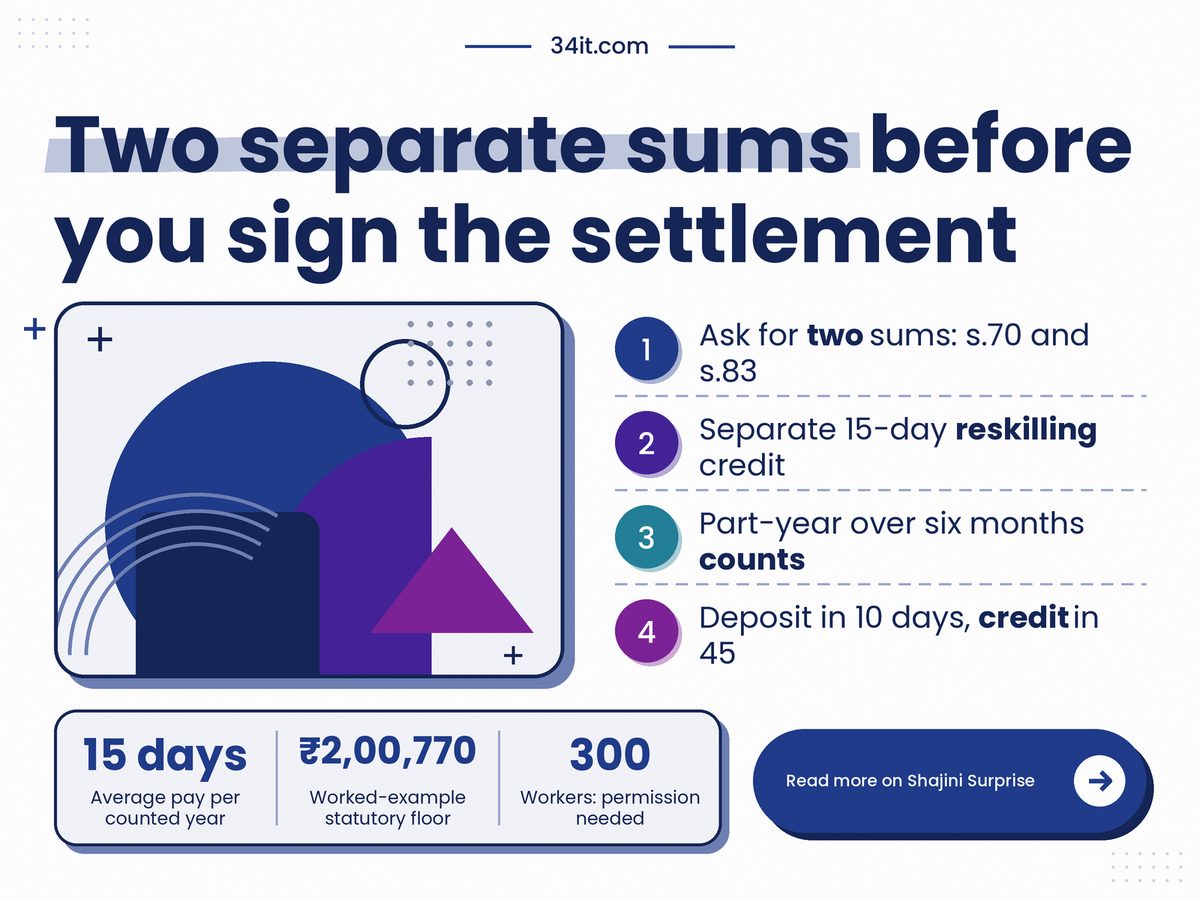
Key Takeaways: a retrenched "worker" with a year's service is owed two separate sums: 15 days' average pay per counted year, and a 15-day reskilling credit paid through a government fund.
- Any service beyond six months past your last work anniversary counts as a full year.
- The base is Code "wages", so allowances above half your pay are added back.
- Supervisors above the notified pay line, and anyone in a mainly managerial role, fall outside both sums.
- Check the reskilling credit first; it has its own deadline.
How is retrenchment compensation calculated in India?
You multiply 15 days' average pay by your completed years of continuous service, counting any part-year over six months as a full year, where average pay is your Code wages over the last three complete calendar months.
Two definitions do the work. "Wages" in s.2(zq) leaves out items such as HRA and conveyance, but if those exceed half of total pay, the excess is added back. That is the proviso behind the 50% wage rule that cut take-home pay, and here it works for you: a thin basic no longer shrinks the base.
Timing decides which law applies. A Ministry of Labour release (PIB, 8 December 2025) confirms all four labour codes came into force on 21 November 2025, so a later retrenchment falls under this formula, not the Industrial Disputes Act of 1947. Our view: any guide still built on the 1947 Act describes the wrong payout, since that Act had no reskilling credit. Gratuity stays a separate claim; see the new gratuity rules on one year of service.
Four thresholds in the Code (Act 35 of 2020) decide whether the formula reaches you, and how big the base is:
Rehire Preference Window
12 months
Keep your retrenchment letter safe
Supervisor Pay Line
₹18,000 a month
Supervisors above it lose cover
Headcount Needing Permission
300 workers
Old Act's line was 100
Allowance Cap in Wages
50% of pay
Excess raises your compensation base
The allowance cap moves the most money for IT staff. A lean basic with a fat flexible component used to shrink every statutory payout; now the excess flows back into wages. Check the base against your last three pay slips, not your offer letter.
Your job title does not decide whether you are owed both sums. What you do all day decides it, and for supervisors, one pay line.
What your exit should pay, by years and wage
For IT workers on ₹30,000 to ₹60,000 of monthly Code wages with two to twelve counted years, the two statutory sums together run from roughly half a lakh to four and a half lakh rupees, before notice pay.
Worked example: take an engineer in a firm below the permission headcount, retrenched after 4 years 7 months, on a monthly gross of ₹90,000: basic ₹36,000, HRA ₹18,000 and ₹36,000 of other excluded allowances. Excluded items total ₹54,000, which is ₹9,000 over half the gross, so Code wages are ₹36,000 + ₹9,000 = ₹45,000. Assume a 26-day month: ₹45,000 ÷ 26 × 15 = ₹25,961.54 per 15-day block. Seven months is more than six, so service counts as 5 years, and s.70 pays 5 × ₹25,961.54 = ₹1,29,808. The s.83 credit is one more block, ₹25,962, paid once. A month's wages in lieu of notice adds ₹45,000. On the rounded figures, the statutory floor is ₹2,00,770. A 30-day divisor pays less, so check which one your employer used.
Find your counted years, then read across at your monthly Code wages; each cell is s.70 compensation plus the s.83 credit.
| Years counted | ₹30K/mo | ₹45K/mo | ₹60K/mo |
|---|---|---|---|
| 2 yrs | ₹0.52L | ₹0.78L | ₹1.04L |
| 5 yrs | ₹1.04L | ₹1.56L | ₹2.08L |
| 8 yrs | ₹1.56L | ₹2.34L | ₹3.12L |
| 12 yrs | ₹2.25L | ₹3.38L | ₹4.50L |
The shaded cell, 5 counted years at ₹45K, is the worked example minus notice pay; each extra counted year adds ₹17,308 in the left column and ₹34,615 in the right. Your one-minute check: count the months since your last work anniversary, because anything beyond six adds a year. At or above the permission headcount, s.79 demands three months' notice, lifting the example's notice pay to ₹1,35,000 and its floor to ₹2,90,770.
Where the worked example's floor goes
The reskilling credit is the smallest slice but the only one with its own government deadline, so chase it separately. Shares are derived from the ₹90,000-gross, 4-years-7-months example.
Is a software engineer a "worker" under the Code?
In most cases yes, because s.2(zr) covers technical and skilled work done for hire, and for private IT staff it excludes only people employed mainly in managerial or administrative roles and supervisors whose wages exceed the notified monthly line.
The test is what you do, not what HR calls you. An engineer who codes all day is a worker at any salary; a lead who signs off leave and appraisals is likely "supervisory", and above the pay line loses both sums. The grey area, in our view: the Code never defines "mainly", so a lead who still spends most hours on delivery has a fair argument to stay inside.
The credit runs on its own clock. PRS Legislative Research's summary of the Industrial Relations (Central) Rules, notified on 8 May 2026, says the employer deposits 15 days' last-drawn wages within 10 days of retrenchment and the worker is credited within 45 days. The Code counts from retrenchment; the Rules, as PRS reads them, from the deposit. So the outer limit is day 55 (or day 45, if your state follows the Code's wording; most private IT firms answer to state rules). Firms at the permission headcount must also apply at least 60 days ahead, and s.79(7) makes a retrenchment without permission illegal.
- A "performance exit" or a resignation request is not retrenchment.
- One compensation line on the final statement usually means the credit was folded in.
- Leave encashment is separate again: how leave encashment days get paid.
- A bond deduction needs a real loss behind it: why your employment bond has a proof problem.
Before you sign, check that:
- your letter says retrenchment, with no misconduct and no resignation named;
- the statement names its day divisor and the three months it averaged;
- if your title says lead, most of your week is delivery, not sign-offs;
- s.70 compensation and the s.83 credit appear as separate lines.
The decision is whether to sign, and the answer is only when both sums are on the page. If yours shows one, write to HR this week for the s.70 figure, the s.83 deposit date and the divisor used; if the credit misses the outer limit, raise it on the Ministry of Labour's SAMADHAN portal after checking your state's rules. This is wrong for you only if your role was mainly managerial, where your contract governs instead.
How we checked this
We read the Industrial Relations Code, 2020 (ss.2, 70, 72, 79, 83), the Industrial Relations (Central) Rules, 2026 (notified 8 May 2026), PRS's bill-track summary and the PIB release of 8 December 2025. The worked example assumes ₹90,000 gross, ₹36,000 basic, a 26-day month and 4 years 7 months of service. No product was tested hands-on for this article, and no employer's settlement was reviewed. Last verified: 24 October 2026.
Edited by Shajini, reviewed after publication. Spotted something out of date? Tell us and we will correct it.
No comments:
Post a Comment
Note: Only a member of this blog may post a comment.