The clause sits near the end of most Indian IT offer letters: leave before your notice period ends and you pay your salary for the days you skip. That payment is a notice period buyout, and some exit bills now add a second line under it: 18% GST. The tax department said so in August 2022, and two High Courts have since agreed.
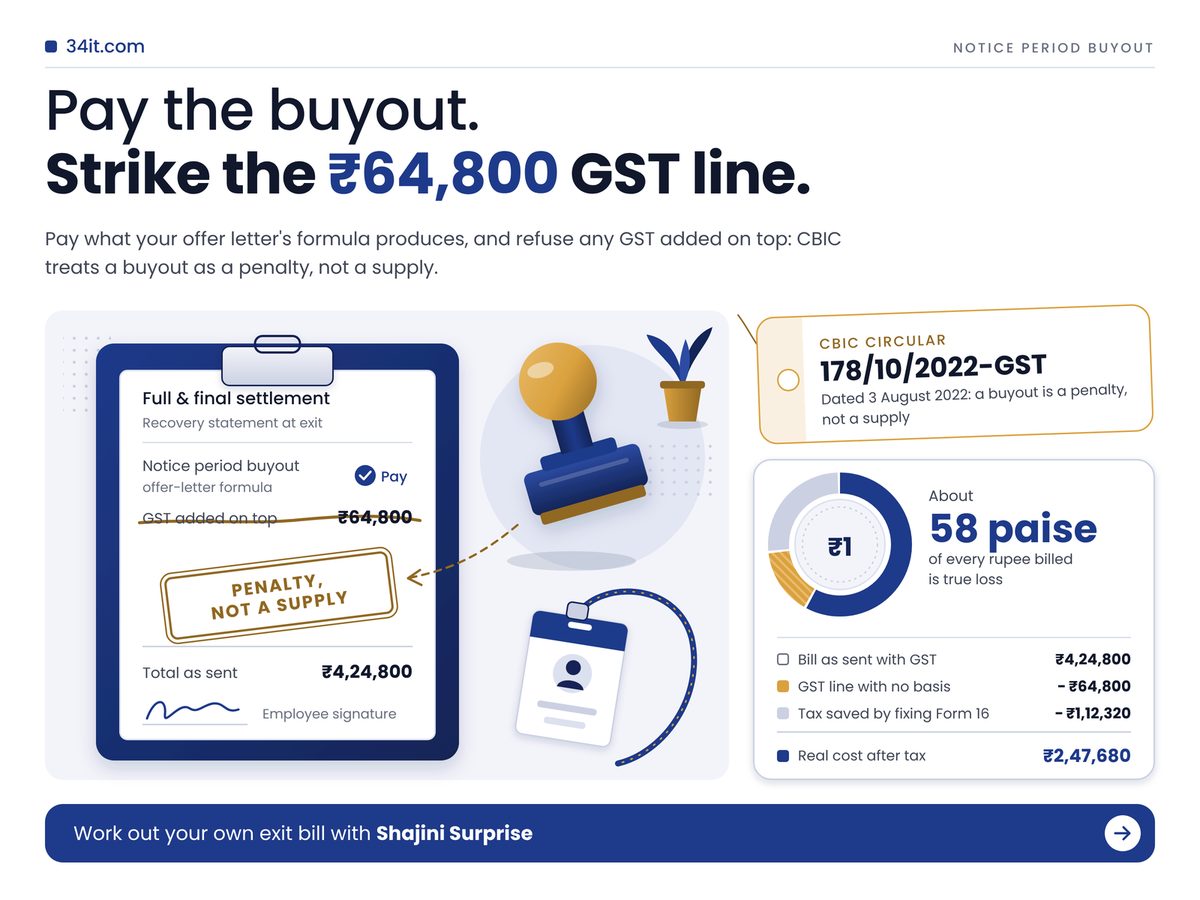
Key Takeaways: Pay your offer letter's buyout formula and refuse any GST added on top.
- CBIC Circular 178/10/2022-GST (3 August 2022) treats salary forfeited for leaving early as a penalty, not a service, so no GST applies.
- The Kerala and Gujarat High Courts have treated GST paid on notice pay as refundable.
- An ITAT Ahmedabad ruling taxes only salary you kept, so the recovery should come off Form 16 income.
- If your marginal tax rate tops 18%, fixing Form 16 saves more than refusing the GST.
Is GST applicable on notice period buyout?
No, GST does not apply to salary you pay back for skipping notice, because CBIC Circular 178/10/2022-GST treats it as a penalty that buys the employee nothing, so it is not consideration for any supply. Read the circular itself: paragraph 7.5 never says "notice period". It covers "forfeiture of salary" when an employee leaves before the agreed period, adding that the employee "does not get anything in return".
The Kerala High Court read notice pay into that line in Manappuram Finance (2022), as reported by Taxmann, and called the circular clarificatory, so it reaches exits before August 2022 too. The same paragraph covers an employment bond's proof problem.
The 18% line mostly traces to one Gujarat case. Amneal Pharmaceuticals' advance ruling, reported in November 2021, held GST payable. Its appeal split between the two members on 9 February 2022, and under CGST Act s.101(3) a split means no ruling issues. An HR policy citing Amneal cites nothing.
The practice outlived the law. An undated complaint on Medium says an employer "recovered the Notice period shortfall amount with 18% GST".
Four numbers set how hard you can push. They come from the Gujarat High Court's 2025 Aculife Health Care ruling (TaxGuru's report), the Model Standing Orders notified on 8 May 2026 (JSA's reading) and Code on Wages s.18.
Wages Due After Resignation
2 working days
Any netting must fit this
GST One Employer Paid on Notice Pay
₹45.14 lakh
Ruled never tax, refundable
Workers Before Standing Orders Apply
300
Smaller firm: contract alone governs
Cap on Listed Wage Deductions
50%
Of one wage period's pay
The refund card is a warning. Aculife paid the tax itself, and the court held it was never tax, with the two-year refund clock running from 3 August 2022. On that reading, pre-circular claims shut on 3 August 2024 (our arithmetic), so refuse GST at the bill. If your buyout runs on basic pay, see how the Code on Wages add-back reshaped basic pay.
The employee does not get anything in return. CBIC wrote that in 2022, and no HR invoice turns it back into a service.
What each line of a buyout bill should say
A correct buyout bill shows one line, the contract formula applied to the days you did not serve after leave set-off, with no GST, and your Form 16 should then show only the salary you kept. In Nandinho Rebello v. DCIT (18 April 2017), ITAT Ahmedabad taxed only the salary actually received after ₹2,76,744 of notice pay was held back, per BCAJ's case note. Your relief is your marginal rate on the recovery; GST is a flat 18%. Above an 18% marginal rate, Form 16 matters more than the GST, and most advice gets that order backwards.
Worked example: assume ₹2,40,000 monthly pay used for the buyout, a 90-day notice period, 30 days served, 15 leave days set off, and a 31.2% marginal rate (30% slab plus 4% cess). Unserved days: 90 minus 30 minus 15 is 45. A day's pay is ₹2,40,000 divided by 30, or ₹8,000, so the buyout is ₹3,60,000. Add 18% GST and the bill reads ₹4,24,800, of which ₹64,800 has no basis. Keeping the recovery out of taxable salary saves ₹1,12,320. Real cost: ₹2,47,680, or ₹1,77,120 below the bill. Try your own pay below; it takes under a minute.
Find the row matching your exit bill and read across.
| If you | Do this | Because |
|---|---|---|
| 🧾 See GST billed | Ask HR to delete it in writing | Circular 178, para 7.5: not a supply |
| 💰 Quoted flat sum | Pay the offer-letter formula only | Contract Act s.74 caps it at the named sum |
| 📊 Form 16 gross | Ask for salary net of recovery | At the 30% slab, ₹31,200 saved per ₹1 lakh |
| ⚖️ Face F&F netting | Consent in writing after checking the sum | s.18 lists no buyout deduction |
| 🛠 None apply | Pay the formula sum, keep the receipt | Proof the contract is settled |
On the flat-sum row, Indian Contract Act s.74 limits breach compensation to a reasonable amount no higher than the sum the contract names.
Where a GST-loaded buyout bill really goes
Of every rupee on a GST-loaded buyout bill, only about 58 paise is a true loss, so win back the other two slices first. Derived from the worked example, with GST nil per Circular 178/10/2022-GST.
Can notice pay be deducted from full and final settlement?
In practice yes, employers net a buyout from your full and final settlement under the contract or your signed consent, though Code on Wages s.18 does not list notice recovery among the deductions it permits from wages. That is the grey area. Our view: netting rests on your contract and consent, not the Code, so ask for it in writing and challenge any figure above the formula. We found no ruling that tests this under the new Code.
Covered establishments must issue a service certificate within 10 days of resignation under the 2026 Model Standing Orders, so holding it over a disputed GST line is their problem. Each leave day set off also cuts the buyout by a day's pay; weigh that against the leave encashment rules (or, more precisely, what your policy pays per day).
- Rebello is a 2017 tribunal ruling; outside Gujarat it persuades but does not bind your assessing officer.
- JSA flags state exemptions such as Karnataka's for IT and ITES firms.
- Pay the undisputed formula amount on time, so only the GST stays open.
Before you pay, check four things
- Your exit bill shows a line marked GST, CGST, SGST or IGST.
- Your offer letter names the days and basic or gross.
- Your Form 16 Part B shows gross salary before the recovery comes off.
- HR can show certified standing orders that cover your role and state.
The decision is to pay the formula, not the invoice. This week, before signing your F&F, email HR asking them to remove the GST line under Circular 178/10/2022-GST, paragraph 7.5, and to issue Form 16 net of the recovery. This is wrong only if the bill shows no GST and Form 16 is already net, so check Part B first.
How we checked this
We read CBIC's Circular 178/10/2022-GST (3 August 2022) in full, the Gujarat High Court's Aculife ruling (2025) in TaxGuru's report, ITAT Ahmedabad's Rebello order (18 April 2017) in BCAJ's note and JSA's May 2026 note on the Model Standing Orders. The worked example assumes ₹2,40,000 monthly pay, 45 unserved days and a 31.2% marginal rate. No exit bill was audited first-hand, and none of this is legal or tax advice. Last verified: 30 October 2026.
Edited by Shajini, reviewed after publication. Spotted something out of date? Tell us and we will correct it.
No comments:
Post a Comment
Note: Only a member of this blog may post a comment.