The Code on Wages, 2019, section 14 sets overtime at “not less than twice the normal rate of wages.” It never says when overtime begins, and for overtime pay for IT employees that silence decides the claim: your State fixes the normal day, and your offer letter may already have spent the extra hours inside your base salary. The employer pays double only when both questions go your way.
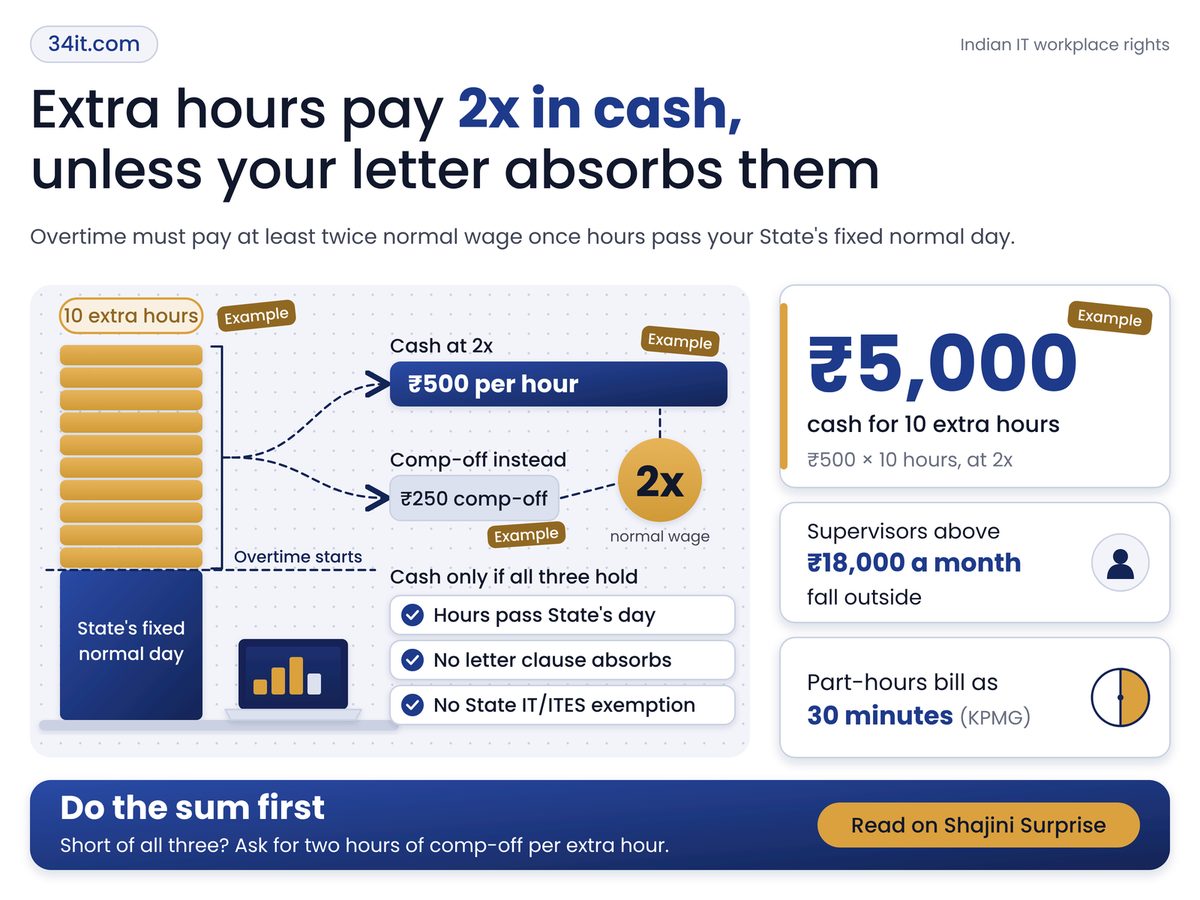
Double pay is in the Code, but you claim it only when every test below holds.
- The Code sets the multiple at 2x; your State fixes the normal working day.
- Claim 2x only when all hold: hours past the State-fixed day; no letter clause absorbing them; no State IT/ITES exemption. Otherwise log hours and ask for comp-off.
- Your hourly rate is monthly wages over contracted monthly hours; the Code never defines “normal rate of wages”.
Is overtime pay for IT employees really double?
Yes, on paper: both the Code on Wages and the OSH Code set overtime at twice the normal wage rate. But each leaves the trigger, the hours beyond which the double rate starts, to the government.
Section 14 covers an employee “whose minimum rate of wages has been fixed” by the hour, the day or a longer prescribed period. It pays “for every hour or for part of an hour” beyond a normal working day. Section 13 lets the appropriate Government fix that day’s length, and the Code names no figure. So “extra” starts where your State says. Not where your day starts to feel long.
The OSH Code’s section 27, in force since 21 November 2025 per India Briefing, pays “twice the rate of wages” for work beyond the hours the government prescribes, counted daily or weekly, “whichever is more favourable to such worker”. A proviso requires the worker’s consent, so extra hours are asked for, not assumed. Our note on leave encashment under OSH Code section 32 covers your leave balance.
Two Codes, one multiple, different reach. The OSH Code’s section 2(1)(zzl) excludes anyone “employed mainly in a managerial or administrative capacity”, and supervisors above a notified pay ceiling. Our reading: a team lead who mostly assigns work is likely outside; an engineer doing “technical” work is likelier inside.
Four numbers decide most claims. Two sit in the Codes and two come from KPMG’s summary of the Central Rules notified on 8 May 2026.
Minimum Overtime Multiple
2x
On every qualifying extra hour
Part-Hour Rounding
30 minutes
A 20-minute stretch bills as this
Quarterly Overtime Cap
144 hours
Central figure, States may differ
Supervisor Pay Ceiling
₹18,000
Supervisors above it fall outside
Divisor and wage base set your hourly rate. KPMG reports a monthly-paid worker’s daily wage as one twenty-sixth of the month, the hour an eighth of that. A 30-day calendar divisor cuts the rate by about 13%, our arithmetic. Which pay counts is the other lever: the 50% wage rule shows how basic pay can shrink.
The 2x is the only fixed part of this rule. When it starts, and on which pay, is left to your State and your offer letter.
How is overtime calculated in India?
Divide your monthly wages by your contracted working hours in the month, then multiply by two for each qualifying extra hour. The Code names the 2x, but the divisor and the wage base are conventions you can contest.
Section 2(y) defines wages as “all remuneration whether by way of salaries, allowances or otherwise”, counting basic pay and dearness allowance but not house rent or conveyance allowances. “Normal rate of wages” is defined nowhere, odd for a formula. Our view: basic plus dearness allowance is the defensible floor; gross is the opening ask.
Worked example: assume ₹52,000 a month counted as wages, a 26-day month and an 8-hour day, so 208 contracted hours. Hourly rate: ₹52,000 divided by 208 is ₹250. Ten extra hours at 2x: 10 × ₹500 = ₹5,000. Repaid one-for-one in comp-off: 10 × ₹250 = ₹2,500. We call this your Overtime value; the gap is ₹2,500 a month. Every input is an assumption (example).
Which row is yours? Find your situation below, then read across for the move and the reason.
| If you | Do this | Because |
|---|---|---|
| ⏱ Past State day | Log hours; claim 2x in writing | Section 14 sets the multiple |
| 🧾 Base-pay clause | Ask HR which hours it covers | Letters can fold extra work into base |
| 💰 Comp-off offer | Ask for 2 hours off per hour | Matches the 2x in time, not cash |
| 🏁 Not sure | Log hours daily, keep proof | A dated log backs any later claim |
Comp-off is where most disputes land. A commenter on r/developersIndia, in an unpaid-Saturdays thread dated by its post ID to early 2025, wrote that extra work should be “compensated either by paying OT to the people who are working or by providing compensatory off”. One reader’s view, not a statistic.
This graphic settles whether a comp-off offer is a fair swap: an extra hour is worth two hourly wages in cash, one as one-for-one comp-off, and none once your letter absorbs it. Our arithmetic from the 2x floor in section 14; the comparisons are not legal rates.
Where the double rate stops working
Three limits can erase the 2x, and the first is the one most engineers never check: whether the law counts you as a worker at all.
The sharpest limit is judicial. As the Law School Policy Review (18 May 2026) reports, the Supreme Court’s 1968 Hatta ruling denied overtime to workers paid above the statutory minimum, and Surat Municipal Corporation (2024) leaned on it again. The review argues section 14 no longer supports that. Courts have split. Our view: the review is right, but not yet settled.
The quieter limit is your offer letter. On Team Blind in November 2025, one commenter said an offer letter states that extra work is covered by the higher base salary. That is anonymous reader evidence, not our finding. Whether such a clause can cancel a statutory multiple is untested in the sources read here, so ask HR which hours it covers.
- State relaxations: India Briefing (December 2025) reports several southern States, Telangana among them, relaxed IT/ITES overtime limits, without dates. Read your State’s notification.
- On-call hours: log them as hours, and see who pays for work phone bills in India.
Check these about your own job before you send a claim
- Your offer letter says a higher base “covers” extra work.
- Your title says lead or manager, but your day is mostly hands-on technical work.
- Your employer cites a State IT exemption but gives no notification number.
- Your basic pay is a small slice next to your allowances.
Do one thing this week: count last month’s hours past your State’s fixed normal day and enter them in the calculator for your Overtime value. If the count is above zero, your letter has no absorbing clause and your State has no IT/ITES notification, claim cash at 2x in writing. Otherwise ask for two hours of comp-off per extra hour, since one-for-one pays half. The check is your State labour department’s notification plus the extra-work sentence in your letter. The call is wrong for managers, supervisors above the notified ceiling, and anyone the Hatta line catches.
How we checked this
We read the Code on Wages, 2019 and the OSH Code, 2020 on 17 November 2026, plus the Law School Policy Review analysis of 18 May 2026. Central Rules figures come from KPMG’s summary, not the gazette text. The worked example assumes ₹52,000, 26 days and 8 hours. No product was tested hands-on for this article. Last verified: 17 November 2026. Edited by Shajini, reviewed after publication. Spotted something out of date? Tell us and we will correct it.
No comments:
Post a Comment
Note: Only a member of this blog may post a comment.