Monday, September 14, 2026

New Gratuity Rules 2026: One Year Counts

The clause runs to one sentence. Where an employee completes one year of continuous service, gratuity shall be applicable on a proportionate basis. That is the whole of it, published by the Press Information Bureau in its Code on Social Security factsheet on 22 November 2025, a day after the four labour codes took effect. And the new gratuity rules 2026 inherited from that line have already changed what a fixed-term contract at an Indian IT services firm is worth on the way out. Nobody sent you an email about it. Your offer letter still says five years, because your offer letter was written before the codes existed.

Timeline graphic explaining the new gratuity rules 2026 for fixed-term Indian IT employees

Key Takeaways

If you are on a fixed-term contract, gratuity now starts accruing at one year instead of five, and it is paid pro rata.

  • Permanent employees are untouched: the five-year continuous-service rule still governs them.
  • The entitlement runs from 21 November 2025 forward, not backward over service you have already given.
  • Part-years above six months count as full years, so your exit month can change the payout.
  • Your appointment letter and payslips are the only proof of continuous service you control. Keep them.

Why The New Gratuity Rules 2026 Cut Two Ways

The one-year entitlement applies to fixed-term employees only, so the same reform that hands a contract worker a real exit payment also gives employers a reason to think harder about who gets a fixed-term paper and who gets a permanent one.

Here is the part the coverage keeps missing. A fixed-term employee at month thirteen now has a statutory claim that a permanent colleague at month thirteen does not. That is not a drafting accident. Fixed-term hiring in Indian IT grew precisely because it carried no tail: no gratuity, no retrenchment friction, no long service liability. The Code on Social Security took the cheapest part of that arrangement away. What it did not do was make fixed-term work safer. It made it costlier, and cost gets managed.

The bills arrived fast. Forbes India reported in January 2026 that TCS booked a statutory charge of Rs 2,128 crore in the third quarter of FY26, which pulled its profit down 13.9 percent year on year. That is one firm, one quarter, one set of provisions being trued up. Read that alongside the EPF withdrawal lock that now delays how much of your corpus you can actually take and a pattern shows up: your statutory entitlements are growing on paper while the time and conditions attached to reaching them are growing too.

New eligibility

1 year

Fixed-term staff, pro rata

Accrual rate

15/26

Days of wages per year served

Payment window

30 days

Interest accrues after that

Q3 FY26 charge

Rs 5,000 cr

Six IT majors, one quarter

Those four numbers describe the same reform from two ends. Two of them are what you can claim, one is how fast the money has to reach you, and the last is what the industry booked when its accountants finally priced the first three. Fisher Phillips, writing for employers in March 2026, put the payment obligation plainly: calculate, notify, pay, and carry interest if you miss. That is a harder deadline than most exit processes in this industry currently hold to, and it sits right next to India's 48-hour full and final settlement deadline, which covers the rest of your dues.

"

Your contract type, not your performance, now decides whether you leave with a gratuity cheque or a handshake. That is the whole reform, and it was never designed to be neutral.

Do Permanent Employees Still Need Five Years?

Yes, the five-year continuous-service requirement survives intact for permanent employees, payable on termination, superannuation, resignation, death or disablement, and only fixed-term staff got the one-year door, on a strictly proportionate basis.

A lot of the commentary in November treated this as gratuity being cut to one year for everyone. It was not. If you are a permanent employee four years and eight months into your job, nothing about your position changed on 21 November 2025, and anyone telling you otherwise has read a headline and not the clause. What did change sits in the table below, and most of it changes the arithmetic rather than the eligibility.

CategoryDetailInsight
Start date21 November 2025, applied prospectivelyService given earlier does not count
EligibilityFixed-term at one year, permanent at fiveContract type now sets the wait
Wage baseBasic must be at least 50% of total payRaises the base gratuity multiplies
RetrenchmentApproval threshold moved from 100 to 300 workersEasier to cut you before you vest
Part yearsA part-year above six months counts as fullThis is where the doubling happens
Our readingMonth 19 credits two years, month 18 credits oneDerived here, not a published figure
Best suited forFixed-term staff with a renewal date in handTime the exit, do not improvise it

Two rows there deserve a second look together. The wage-base change raises the number your gratuity multiplies against, and the retrenchment change makes it administratively easier to end your employment before the multiplication ever happens. Both are in the same reform package. Whether that nets out in your favour depends entirely on how long you stay, which brings us to the only calculation in this piece that actually matters.

How Is Pro-Rata Gratuity Calculated For A Fixed-Term Employee?

You take the last drawn wage, multiply by fifteen twenty-sixths, and multiply again by years of service, where any completed year counts and a leftover period above six months counts as a whole additional year in its own right.

That last clause is where the money hides, and almost nobody plans around it. Work it through. A fixed-term employee who exits at eighteen months has one completed year plus exactly six months, and six months is not more than six months, so one year is credited. The same employee who stays into month nineteen has one completed year plus a part-year that clears the threshold, so two years are credited. Same contract, same salary, one extra month of work, and the entitlement doubles. That is our own reading of how the completed-year and part-year rules interact rather than a figure any of these sources prints, and it is worth checking against your own appointment terms before you sign anything on the way out.

21 Nov 2025. Month 12. Month 18. Month 19. Exit. Codes in force. Claim opens. One year credited. Two years credited. Payment window opens.

Reading the timeline in plain words: the clock starts when the codes came into force, a fixed-term claim becomes possible at the twelve-month mark, the credited service stays at one year right through month eighteen, and it steps up to two years once month nineteen is reached. The payment window only opens at exit.

Where This Goes Wrong For You

The failure mode is almost never an employer refusing to pay, it is a broken service record, a contract quietly reclassified, or an exit timed three weeks too early, and all three happen during an ordinary notice period.

Continuous service is the load-bearing phrase in the whole clause, and it is also the one most easily damaged. A gap between two fixed-term renewals, a transfer between group entities, a short stint parked on a vendor payroll: each of these can reset the count, and each of them is presented to you as an administrative formality. I would push back on that framing, though I understand why people accept it. The paperwork usually arrives with a raise attached.

Watch for these:

  • A renewal that starts a few days after the previous term ended, rather than the day after.
  • A new appointment letter that changes the employing entity while your desk, manager and project stay the same.
  • A relieving letter that omits the start date, or gives a start date that does not match your first payslip.
  • An exit date proposed by your manager that lands just short of a month boundary you have been counting toward.
  • A settlement statement that lists gratuity as nil without stating which rule it applied.

If your contract says fixed-term: count your months from the start date on your first appointment letter, not from when the codes took effect, then check which side of the part-year threshold your planned exit falls on.

If your contract says permanent: nothing here changes your eligibility, but the wage-base rule may quietly change what your eventual payout multiplies against, so read your revised salary structure rather than your net credit.

If you cannot tell which you are: that is itself the finding. Ask HR in writing which classification your service is recorded under, and keep the reply.

Does Resigning Before Five Years Mean No Gratuity At All?

For a permanent employee, yes, resignation before five years of continuous service still leaves you with nothing on this head. For a fixed-term employee past the one-year mark, no, the proportionate entitlement survives resignation.

This is the sharpest split the reform created, and it deserves more attention than it is getting. The same resignation letter produces two completely different financial outcomes depending on a classification most employees never chose and many cannot name. If you are watching the silent layoff signals most tech workers miss and thinking about jumping first, the classification question comes before the timing question. And if your reason for leaving is the commute and the anxiety that came with forced return to office, it still comes first, because the answer can be worth a month of pay.

This week, pull out your appointment letter and your most recent payslip, and confirm three things in writing with HR: your recorded classification, your recorded date of continuous service, and the rule under which your gratuity will be computed at exit. Do it now, while you are not negotiating anything. The answers are much harder to get once you have resigned.
Monday, September 7, 2026

Airtel Voice Only Plan Saves You Rs 1,750

Your second phone sits in a drawer. It takes calls from the bank and the school, it forwards an OTP now and then, and it has never opened an app in its life. The recharge you buy for it still ships with two gigabytes a day, because that is what the shop offers and what the app pre-selects. An Airtel voice only plan exists for exactly this handset. Almost nobody is sold one.

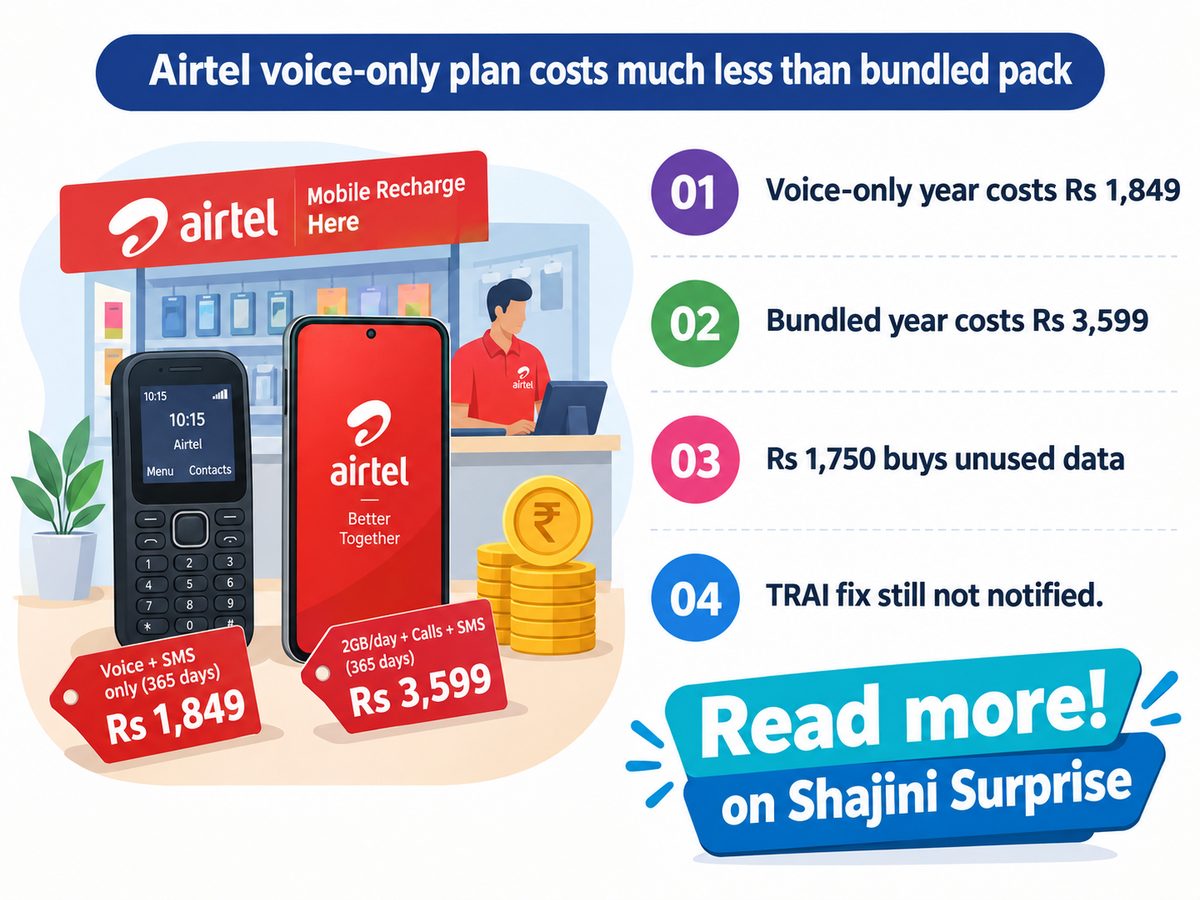
Airtel voice only plan compared with bundled yearly recharge cost in rupees

An Airtel voice only plan costs Rs 1,849 a year against Rs 3,599 for the bundled pack, a Rs 1,750 gap on a phone that never uses data.

  • Voice and SMS vouchers became mandatory in December 2024, but only at two validity lengths.
  • TRAI's April 2026 draft would require one voice-only voucher for every bundled validity.
  • Jio, Airtel and Vodafone Idea opposed that draft, and it remains unnotified.
  • Voice-only vouchers rarely surface in the app's default recharge view.

Can I get only voice call recharge plan?

Yes. Since 23 December 2024 every Indian operator must sell at least one Special Tariff Voucher carrying voice and SMS alone, a rule the Telecom Regulatory Authority of India notified as the Twelfth Amendment to its consumer protection regulations.

The rule works. Or rather it half works, because it said one voucher and the operators heard one. They parked their voice-only packs at the long validities and left every shorter duration to the bundled plans, which is where the margin sits. Want to pay for calls alone? Buy a year of them, or buy nothing.

That is not a small drafting oversight. It is the whole difference between a right on paper and a product on a shelf, and Indian telecom customers know the difference well enough by now. Anyone who has fought Airtel's automated support loop has met the same logic: the service technically exists, and reaching it is your problem. The operators now arguing that cheap short-validity packs would arm spammers are the same companies that ran the KYC display-name push against mobile scams. The fraud risk is real. It is also convenient.

Four numbers explain why the regulator came back for a second attempt in 2026. They describe how long the first rule was left to work, what data costs at the bottom of the market, how many people are billed for data they never touch, and how little of the network those people actually use.

Rule to redraft

15 months

Mandate to fresh draft

Entry pack data

Rs 94-99

Per gigabyte at the bottom

Non-data users

100-150 mn

Indians on feature phones

Legacy traffic

0.17%

Share still on 2G and 3G

The per-gigabyte rate at the entry level is the one that should sting, and it comes from consumer submissions filed at TRAI's open house in June 2026. A buyer down there is not choosing a small pack over a large one to save money. They are paying the highest unit price in the country for an allowance they often cannot use, in circles where the signal will not carry it anyway. Bulk pricing runs the other way in every other market you can name.

"

A hundred million Indians pay for mobile data they never open. That is not a market failing at the edges. That is the default recharge, working exactly as sold.

What an Airtel voice only plan actually costs

Airtel lists a voice and SMS voucher against its yearly bundled packs, and the gap between the two is almost entirely the price of data a drawer phone will never open. The comparison below uses the operator's own published prices.

Read the middle rows carefully, because that is where the argument actually lives. The choice is not really between calling and browsing. It is between buying data by the year at a rate you did not negotiate and buying it by the gigabyte when a need turns up.

DimensionVoice and SMS onlyBundled voice, SMS and data
Yearly priceRs 1,849 for 365 days, 3,600 SMSRs 3,599 for 365 days, 2GB a day
Data includedNone; bought separately as add-on vouchersAbout 730GB a year at the daily cap
Light data routeRs 2,249 yearly pack adds 30GB, Rs 400 over voice-onlyThat same 30GB is spent in 15 days at 2GB a day
Validity choiceClustered at 84 and 365 daysEvery duration the operator chooses to sell
Rule todayAt least one voucher, no ceiling on its priceNo cap on count, price or promotion
Rule proposed7 April 2026 draft: one twin per bundled validityNo new obligation proposed on this side
Best suited forSecond SIM, feature phone, or a handset that lives on home Wi-FiSingle-SIM primary phone with no broadband at home

Run the subtraction yourself and the yearly price of that daily allowance is Rs 1,750. That figure is arithmetic on two published prices, not something either side advertises. The lighter data pack in the middle costs under a quarter of the same gap and still covers a modest user for a full year, which is the part the recharge screen never puts in front of you.

And the billing itself already tells the story. TRAI's own performance report for the quarter ended March 2026 breaks the average monthly bill into its parts, and voice is a rounding error inside it.

Where Rs 196.04 of monthly ARPU goes. Data services: Rs 172.59. Voice calling: Rs 14.91. Everything else: Rs 8.08.

Blended wireless ARPU and its split, from TRAI's Indian Telecom Services Performance Indicator Report for the quarter ended March 2026.

Where the voice-only promise breaks down

It breaks down at the point of sale. The rule requires a voucher to exist, not to be visible, priced in proportion, or offered at the durations people actually recharge for, and every operator has read that gap correctly.

Airtel's shortest voice-only voucher runs 84 days at Rs 469. Someone who wants three months of calls gets exactly one price, take it or leave it, with nothing shorter behind it. That is the complaint the April 2026 draft answers, and it is precisely why the industry fought it, because matching every bundled validity with a voice-only twin turns a token compliance item into a real product line with real margin attached. A regulator can mandate existence cheaply. Mandating proportional pricing across every duration is a different order of intervention, and India has seen how much difference teeth make: the 48-hour full and final settlement deadline only changed behaviour once penalties were attached to it.

Then there is the direction of travel. Morgan Stanley expects prepaid and postpaid tariffs to rise by 16% to 20% across 4G and 5G during 2026, on the roughly two-year cadence the industry has kept since the July 2024 hike. My own reading, and this is opinion rather than anything the filings settle, is that the hike lands before the amendment does. The voice-only voucher gets repriced upward before it is ever made properly available. It would not be the first Indian rule to promise the whole thing and deliver a fraction of it, which is roughly what happened with the EPF rule that lets you withdraw everything while holding a quarter back.

Can I have only voice plan in Jio?

Yes. Jio sells a voice and SMS pack at Rs 1,748 for 336 days, and Vodafone Idea starts its equivalent at Rs 1,770. Both sit close enough to Airtel's yearly price that nobody is really competing on this shelf. Before you switch a SIM over, check what stops working:

  • Anything that needs the handset itself online, from UPI payments to app-based two-factor prompts, will not work without a data voucher or Wi-Fi.
  • A smartphone on a voice-only voucher is only sensible where Wi-Fi covers most of the day, since background sync and OS updates have nowhere else to go.
  • Voice-only vouchers are usually missing from the app's default recharge screen, so open the full plan list or the website to find them.
  • Operators have argued on record that cheap short-validity packs help spammers, so expect any new short voucher to arrive with a tighter SMS cap than the yearly one.

Three things worth knowing before your next recharge

The Rs 10 top-up survived. The 2024 amendment forced operators to keep a Rs 10 top-up voucher on sale, which is still the cheapest way to hold a number alive between packs.

Validity now runs to a full year. The same amendment lifted the ceiling on Special Tariff Voucher validity from 90 days to 365, which is exactly why yearly voice-only packs exist at all.

The counter-argument is on the record. Jio told the regulator that 88% of its entry-level subscribers actively use data, which is the number the whole case against short voice packs rests on.

Open Airtel's website rather than the app, find the voice-only list, and look at it before your next recharge falls due. If the phone in question is a second SIM, a parent's feature phone, or a handset that spends its day on home Wi-Fi, buy the year of calls and add data by the gigabyte when something actually needs it. That one change is worth more than any plan comparison you will read this year, and it takes about four minutes.

Saturday, August 22, 2026

PF Withdrawal Rules 2026: Why 100 Percent Actually Means 75

The email lands on a Friday. Your role is redundant, your last working day is the thirty-first, and HR attaches a settlement sheet you will read four times without really reading it. Somewhere in that afternoon you open the EPFO portal. Years of contributions sitting there, yours, and every headline you have seen this summer says you can now withdraw the whole thing.

You can't. Not the whole thing, and not soon.

PF Withdrawal Rules 2026: Why 100 Percent Actually Means 75

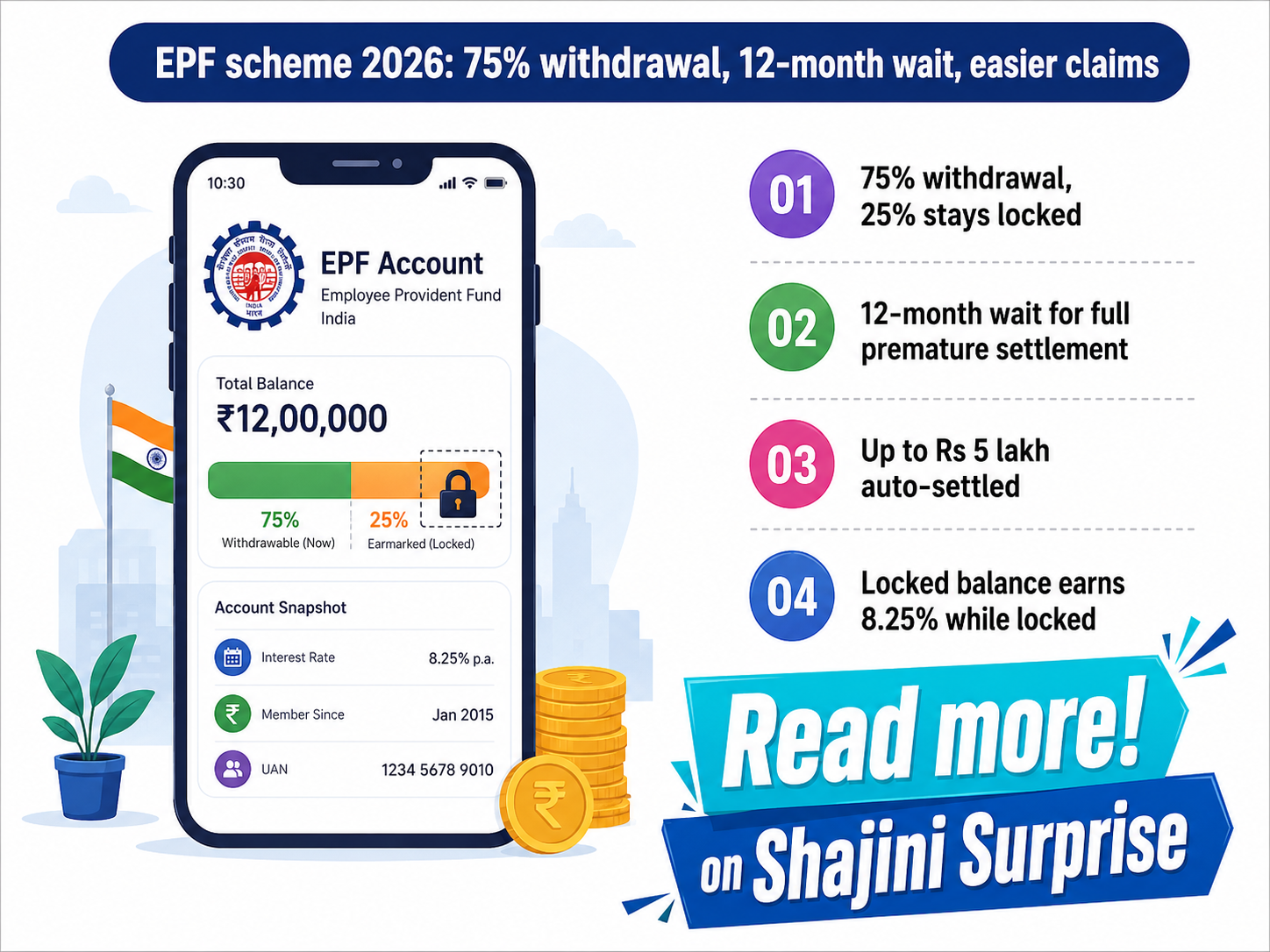
TL;DR: The EPF Scheme 2026 does let you claim 100% of your eligible balance. But a quarter of the account is earmarked and stays put, so the real ceiling is 75%. And the wait for a full premature settlement after leaving a job moved from two months to twelve.

Why The Withdrawal Headline Got It Backwards

The coverage was not wrong. It was incomplete in exactly the place that decides whether you make rent. "Withdraw up to 100%" is a real phrase from a real government release, and it refers to 100% of the eligible balance. Eligible balance is what remains after the scheme earmarks 25% of your contributions as a minimum balance you cannot touch while the account stays open. Do that subtraction and the number on the screen stops being a hundred and becomes seventy-five.

And the framing matters more than usual here, because the people who most need the money are the ones reading fastest. Anyone who has just been through a restructuring knows the mental state. You are scanning for a number, not for a qualifier. If you budgeted your notice period around the full balance and the portal releases three quarters of it, that gap is not an accounting curiosity. It's a month of expenses.

Then there's the part almost nobody led with. The Ministry of Labour and Employment's 13 October 2025 release put the waiting period for a premature final settlement at twelve months, up from two. Read that against what actually happens when a job ends in India. The 48-hour full and final settlement deadline now forces your employer to clear dues fast, which is genuine progress, but employer dues and your own provident fund are two different taps. One got faster. The other got a ten-month longer queue. If your exit was one of the quiet layoff patterns most people miss, where the paperwork says resignation and the reality says otherwise, you are in that queue with no severance argument to make.

Wait for full premature settlement

12 months

Previously two months

Auto-settled claim ceiling

Rs 5 lakh

Cleared without documents

EPFO corpus under management

Rs 28 lakh crore

Members' money, not government money

Interest on the retained balance

8.25%

Compounded while locked

The auto-settlement ceiling is the one worth sitting with, because it is doing quiet work. A claim under that limit clears without a human reading your file and without you uploading anything, which is why settlement times have collapsed for ordinary members. Above it, you re-enter the old world of verification, queries and a regional office. Most salaried members with a decade of service will cross that line at some point, and nothing in the new scheme changes what happens on the other side of it.

"

Two months became twelve. For anyone out of work, that single line decides whether the provident fund is an emergency cushion or a retirement statement they can only look at.

What The EPF Scheme 2026 Actually Changed

Strip the announcements down to what a member experiences at the portal and the changes sort into seven items. Some of them are real improvements. Two of them are the ones you will feel.

Category Detail Insight
Minimum balance 25% of the eligible balance is earmarked and stays in the account A quarter never leaves the account
Real ceiling Three quarters of the account is the true maximum you can pull Hundred percent means three quarters
In force from The EPF Scheme, 2026 took effect on 29 June 2026 Already live, not a future proposal
Pension exit The EPS withdrawal benefit now carries a 36-month wait Three years before pension money moves
Categories Housing, essential needs, and special circumstances replace the old list Thirteen old provisions folded into three
No-reason route Twice a year under special circumstances, no justification required Two free passes, no questions asked
Confirmed in A Lok Sabha reply on 10 August 2026 restated the new waiting periods Stated on the floor this month

Read as a whole, the scheme is a trade. Speed and simplicity on the way in, friction on the way out. Thirteen fiddly provisions collapsing into three plain categories is a genuine win, and the twice-yearly no-questions route is more flexibility than members have ever had for a small emergency. The bill for all of that is paid by the person whose emergency is not small.

Your EPF account under the new scheme   75% you can actually reach  ·  Locked

The bar is drawn to scale: the shorter block on the right is the portion of your own account that stays where it is, no matter which category you claim under.

Where This Quietly Costs You

Policy arguments for the lock are easy to make, and some of them are good. Provident fund balances in India get emptied at the first job change and rebuilt from zero, which is how people reach fifty with a corpus that looks like it belongs to a thirty-year-old. Forcing a floor under the account interrupts that habit. Fine. I agree with the goal.

Whether it works is a different question, and this is where I think the confident takes on both sides are running ahead of the evidence. Nobody has published the counterfactual: how many members, blocked from their own savings during a bad stretch, ended up on a personal loan or a credit card at rates no provident fund has ever paid. I have a hunch about which way that number falls. I don't have the data, and honestly, neither does anyone arguing the opposite. Treat anyone who sounds certain about it as someone with a position rather than a finding.

What is not in doubt is who absorbs the friction. Someone with a working spouse and six months of runway will barely notice a twelve-month wait. Someone laid off from a single-income household, already stretched by the commute and the health costs that come with it, notices immediately. Add the tax load salaried employees already carry and the picture gets clearer. The people with the least cushion are the ones the waiting period lands on hardest.

Things worth checking before you plan around any of this:

  • Your eligible balance on the portal is not your account balance. Look for the earmarked portion before you commit to a number.
  • A partial withdrawal under one of the three categories is a faster route than waiting out a premature final settlement, and most people asking for a final settlement do not actually need one.
  • If your claim crosses the auto-settlement ceiling, expect the older, slower verification path and plan your timeline around that, not around the headline turnaround.
  • The pension component moves on its own clock and it is a much longer one. Do not blend the two in your head.
  • Keep your KYC and exit date correct at the employer's end. Almost every rejected claim traces back to a mismatch there, not to the new rules.
10x  Education claims   ·  5x  Marriage claims   ·  1 year  Service to qualify 

Those three limits are the flexibility the scheme did buy you, and they are worth knowing before you assume the only door is a final settlement.

So do the arithmetic yourself before you plan around a number a headline gave you. Log in, find the earmarked portion, subtract it, and build your exit budget on what is left. Then pick a partial withdrawal category instead of a final settlement, because for most people leaving a job this year, that is the difference between money in October and money next August.

Friday, July 24, 2026

India's 48-Hour Full And Final Settlement Deadline Now Carries Penalties

Your last day ends at 6pm. Badge surrendered, laptop wiped, farewell email sent to a distribution list that will forget you by Thursday. Then the waiting starts. Six weeks of it, in the version most Indian employees still quietly expect, while HR says the settlement is "in process" and payroll says it runs with the next cycle. That wait is no longer a bureaucratic inconvenience you simply absorb. As of this month, it is a punishable delay.

India's 48-Hour Full And Final Settlement Deadline Now Carries Penalties
India's four Labour Codes make your wages payable within two working days of resignation, dismissal or retrenchment, and from July 2026 that deadline carries statutory penalties. The gratuity base rose, fixed-term staff qualify far sooner, and how hard the rule bites still depends on which state notified its own rules.

Why The Exit Paycheque Suddenly Has A Clock On It

The four Labour Codes came into force on 21 November 2025, folding twenty-nine separate laws into one framework, and the central government notified the Central Rules on 8 May 2026. Almost all the coverage since has been written for employers — compliance calendars, payroll reconfiguration, cost modelling. The part that matters to the person actually leaving a job got very little airtime: the Code on Wages requires an employer to pay everything owed within two working days of removal, dismissal, retrenchment, resignation or closure. Not a service-level target. A statutory window.

That flatly contradicts the advice every departing employee in India has been handed for a decade. Wait it out. Don't burn the bridge. F&F takes forty-five days, that's just how it works. And for years the advice was accurate, because the old framework left timing to company policy and nobody wanted to fight a former employer over three weeks of interest. It is now wrong, and repeating it costs people real money. The obligation moved out of the HR handbook and into the statute, so the question is no longer whether your company is being reasonable. It is whether your company is compliant.

The enforcement teeth are what separate this from the last decade of well-meaning guidance. A repeat delayed-wage offence within five years now attracts a fine of up to ₹1 lakh alongside possible imprisonment of up to three months. Employers are absorbing a structural cost increase in the same breath: the requirement that basic pay plus dearness allowance make up at least half of total cost-to-company lifts the base on which provident fund and gratuity are calculated, with consultancies putting the manpower cost impact somewhere between five and fifteen percent. Both landed together, which is exactly why some payroll teams are quietly hoping employees never read the wage code closely. The figures below are the ones worth memorising before your exit interview.

Statutory Settlement Window
2 working days
From your last working day
First-Offence Penalty Ceiling
₹50,000
Per delayed-wage violation
Old Laws Consolidated
29 statutes
Now four labour codes
Minimum Basic Share Of CTC
50%
Raises gratuity calculation base

That wage-structure floor is the sleeper change. For years Indian salary packages were engineered with a thin basic component and a fat pile of allowances, because a smaller basic meant smaller provident fund contributions and a smaller gratuity liability at the far end. Rebalancing the structure raises the figure your gratuity is calculated on, so the same tenure now produces a materially larger payout than it would have on a 2024 payslip. Anyone who worked out their exit maths years ago should redo it, because the old spreadsheet understates what is owed.

What Your Employer Actually Owes, Line By Line

Exit money is not one payment. A full and final settlement is a stack of separate entitlements with separate rules, and confusing them is how people talk themselves out of claims they are legally entitled to make. Here is the stack as it stands under the current framework.

Category Detail Why It Matters
Notice period buyout Buyout offsets notice pay only Every other due still stays payable
Gratuity, permanent staff Five years of continuous service Threshold unchanged, but base got bigger
Gratuity, fixed-term staff Pro-rata after one year of service Biggest single win for contract hires
Retrenchment approval Government sign-off threshold now 300 workers Mid-size firms can cut without permission
Retrenchment compensation Notice or pay in lieu, plus service compensation Easier layoffs did not make them cheaper
Severance tax treatment ₹5 lakh exemption under Section 10(10B) Notice pay remains fully taxable income
State rollout Eleven states final, big industrial states drafting Your postcode changes your practical leverage

Read that last row twice. Madhya Pradesh, Uttar Pradesh, Gujarat, Karnataka, Haryana, Uttarakhand, Jharkhand, Odisha, Bihar, Chhattisgarh and Assam have notified final rules. Maharashtra, Tamil Nadu, Kerala, Punjab, Rajasthan, Telangana, Andhra Pradesh and West Bengal are still sitting on drafts — awkward, given how much of the country's IT and manufacturing payroll runs through exactly those states. The sequence below is the one your money should follow once you walk out.

Exit day Wages settled Gratuity paid Interest accrues Handover complete Statutory window Within 30 days On employer delay

Gratuity runs on its own thirty-day clock, and simple interest becomes payable the moment an employer misses it.

Where People Hand Back Their Own Leverage

The most common self-inflicted wound is signing the settlement statement without reading it. People treat the full and final settlement sheet as a formality at the door, initial it on a tablet in reception, and only notice afterwards that the leave encashment used a stale balance or that a retention bonus was clawed back under a clause nobody explained. Once you have signed acceptance of an amount, disputing it stops being a wage claim and becomes an argument about your own signature. Block ninety minutes to reconcile the statement line by line against your payslips before you sign anything. It is the highest-return hour and a half in the entire exit.

There is a real grey area here that nobody in HR or law will resolve cleanly for you. Where a state has published draft rules but not notified final ones, the code applies while the procedural machinery around it — forms, timelines, the officer you actually complain to — is only half-built. Practitioners disagree, in good faith, about how hard an employee in Maharashtra or Tamil Nadu can push the two-day obligation right now. You are relying on a rule that exists federally and is still assembling itself locally, and pretending otherwise helps nobody. Watch for these traps before they cost you money you have already earned.

  • Accepting a verbal figure instead of a written, itemised statement, which leaves you nothing to dispute when the credited amount comes in lower.
  • Letting a notice buyout be quietly netted against gratuity or leave encashment, when it should offset notice pay alone.
  • Missing that your rebalanced basic pay raises the gratuity calculation, and accepting a figure computed on your old salary structure.
  • Assuming an ex-gratia labelled "goodwill" is automatically tax-free, without checking whether it is genuinely voluntary.

Three things to do before you sign anything

Demand the itemised sheet. An itemised statement is the only document you can actually contest later.

Separate your leave encashment. Earned leave is a standalone due and should not vanish into a buyout calculation.

Know your escalation route. Unpaid wage claims go to the labour authority, not back to the manager who ignored you.

If you are already reading the quiet signals that a role is being wound down, or feeling the physical cost of surviving a restructuring round, do the boring thing this week. Pull your last six payslips, check what share of your CTC sits in basic pay, and calculate the gratuity figure yourself. Walk into the exit conversation already knowing the number, because the two-day rule only protects people who know what should have landed.

Related: the new gratuity rules 2026 that now pay fixed-term staff after one year

Friday, July 17, 2026

Silent Layoffs In 2026: Warning Signs Every Tech Worker Misses

You made it. The reorg email landed, half your pod vanished over a single Friday, and your badge still beeps green on Monday. Feels like winning. It isn't, not yet. The restructuring that spared you rarely stops moving after the announced round. It just goes quiet. No press release, no all-hands, no severance headline. One reassigned manager here, one frozen project there, and three months later a calendar invite titled "quick sync" with HR already in the room.

That slow, unannounced version of a workforce cut is the part almost nobody prepares for. It runs on plausible deniability, and it moves at a speed designed to keep you calm while your position quietly erodes. Reading it early is the difference between a planned exit and a blindsided one.

Silent layoffs replace the mass announcement with quiet, performance-framed exits that are hard to see coming. Watch for reorg reshuffles, frozen roadmaps, and shrinking access. Spot the pattern early, build a cash runway, and warm your network before the "quick sync" invite ever lands.
Silent Layoffs In 2026: Warning Signs Every Tech Worker Misses

Why The Quiet Version Is Winning

A silent cut skips the optics problem. There is no viral memo, no stock dip tied to a headcount number, no journalist counting badges. Instead, people leave in ones and twos through what gets labelled performance-linked exits, skill-based restructuring, or a tidy "org redesign." The math still adds up to a large reduction. A 2026 Rest of World report on India's tech workforce described exactly this drift, and staffing firm TeamLease estimated roughly 12,000 quiet exits across Indian tech by May 2026 alone. Globally, more than 119,000 tech roles were cut in the first half of 2026, with AI restructuring cited as the common thread across firms posting record revenue.

The mechanics matter more than the number. Companies are flattening management layers and pushing routine work onto automation, then reframing the surviving-but-redundant role as an individual performance question rather than a business decision. That reframing is the trick. It moves the blame from the balance sheet to you, which quietly lowers the odds you negotiate, escalate, or leave with a package. And because each exit looks isolated, your still-employed coworkers assume it was earned, so the internal warning network that used to protect people barely fires. This is the single most text-dense reality of the whole shift, so the numbers below anchor what it actually costs a household.

Cash Runway Target
6 months
expenses held in liquid cash
Median Out-Of-Pocket Gap
₹3.8 lakh
income lost before re-hire
India IT Roles At Risk
35,000
projected cuts through 2026
Workers Reporting Burnout
83%
India tech, 2026 survey

Sit with that runway figure for a second. Six months of liquid expenses is not a wealth goal; it is a decision-making tool. With a cushion, you can turn down a lowball counter, refuse a humiliating "improvement plan," and interview from a position of calm. Without it, every quiet signal becomes a panic, and panic is exactly the state a slow exit relies on to keep you compliant and cheap.

The Signals, Read In Plain English

Most of the early warnings are boring on their own. A reorg. A new dashboard. A cancelled one-on-one. Any single one means little. The tell is the cluster, several of them stacking inside the same six-week window while nobody says the word "layoff" out loud. Here is how the common signals actually decode.

Signal What You Actually See What It Really Means
Reorg reshuffle Your team folded under a new manager New manager rarely protects old headcount
Metrics creep New KPIs appear mid-quarter Paper trail being built for exit
Project freeze Your roadmap quietly deprioritized No project means no protected role
Access trim Tools or systems access narrowed Early offboarding sometimes starts here quietly
Calendar shift One-on-ones cancelled, skip-levels stop Manager is disengaging before the news
Improvement whisper Vague "let's grow this" feedback appears Improvement paperwork usually precedes quiet cuts

None of these is proof. Read them as smoke, not fire. If two or three land in the same short stretch, stop assuming the best and start moving, because the sequence below tends to run on a predictable rhythm once it begins.

Signal Week 0 Quiet review Weeks 1–3 Access trim Weeks 3–6 Exit sync Weeks 6–8

That rhythm is a common pattern, not a fixed timetable, and plenty of reorgs never reach the last node. The point is that the window between the first signal and the final meeting is usually weeks, not months, so the prep has to start at node one.

Where People Sabotage Their Own Exit

The most common mistake is treating loyalty as a strategy. You put your head down, over-deliver, and assume the work will speak for you. In a quiet cut it won't, because the decision often precedes the review, and effort logged after the fact rarely reverses it. The second mistake is the opposite overreaction, quitting in a visible huff the moment a project stalls, which forfeits any severance and hands the company the clean exit it wanted for free. This is the honest grey area: you genuinely cannot tell a benign reorg from a targeted one with certainty, and both over-trusting and over-panicking carry real costs. You are playing probabilities, not certainties.

There is a physical price too. A 2026 survey of Indian tech workers found one in four now clocks more than 70 hours a week, often in a doomed attempt to look indispensable during exactly these anxious stretches. That grind rarely saves the role, and the health toll is its own tax, a theme covered in the earlier pieces on forced RTO commutes wrecking worker health and why return-to-office mandates quietly erode wellbeing. Watch for these traps before they cost you leverage.

  • Confusing activity with security, so you burn nights polishing work while skipping the resume, portfolio, and reference calls that actually protect you.
  • Emptying savings on lifestyle right after surviving a round, when that surplus is the exact runway a silent exit is about to test.
  • Going silent on your network out of pride, so the day you need a warm intro you are cold-messaging strangers instead.
  • Signing a fast severance or "mutual separation" without reading notice-period, clawback, and non-compete clauses line by line.
Your Two-Week Protection Sprint
2 hours weekly
A standing block to update your resume and scan open roles, treated like an unmovable meeting.
3 references
Reconnect with three people who would vouch for you before you actually need the favour.
1 income stream
Start one small side income now, so a single employer never fully owns your monthly survival.

Pick one signal you have already noticed this month, then finish the two-week sprint before you talk yourself out of it. If silent layoffs are the game, quiet preparation is how you stop being the easy pick, and the worst outcome of over-preparing is that you end up with a sharper resume and more savings for a job you keep.

Sunday, April 26, 2026

Forced RTO Commutes And Layoff Anxiety Are Destroying Tech Worker Health

You survive the restructuring email, keep your badge, and suddenly inherit three departed colleagues’ deliverables. The celebration lasts until Tuesday. By Thursday, your lower back locks up during the ninety-minute commute, your resting heart rate refuses to drop below eighty-two, and you are chugging antacids just to sit through a mandatory stand-up. This is not burnout. This is a physiological tax levied on the people who stayed. The recent headcount reductions at TCS, Oracle India, and Infosys erased roughly ninety-two thousand global roles in the first quarter of 2026 alone, but the clinical fallout lands squarely on the surviving teams forced into rigid office mandates.

Surviving a tech layoff cycle while enduring forced office returns triggers measurable physical decline. Elevated cortisol, chronic muscle tension, and disrupted sleep architecture are direct biological responses to expanded workloads and commute strain. Targeted movement protocols and strict boundary enforcement reverse the damage before it becomes permanent.

Why Survivor Syndrome Wrecks The Nervous System

When headcount shrinks but deliverables stay fixed, the nervous system treats the workload like a physical threat. Think of it like carrying a backpack that gets heavier every week while someone keeps lengthening your walking route. Your adrenal glands flood the bloodstream with cortisol and adrenaline. That chemical surge keeps you alert for sprint deadlines, but it also constricts blood vessels, spikes blood pressure, and halts digestive repair. A 2025 Lancet Public Health occupational cohort tracked exactly this pattern across surviving engineering teams, documenting a direct correlation between post-layoff scope expansion and early-stage hypertension.

Forced RTO Commutes And Layoff Anxiety Are Destroying Tech Worker Health

Mandatory office returns compound the biological load by stripping away recovery windows. A hybrid schedule used to grant two uninterrupted mornings for deep work and regulated sleep cycles. Forcing five-day commutes replaces that recovery with traffic exposure, fluorescent lighting, and performative visibility. Engineers now sit through redundant status meetings just to prove they are present, which keeps the sympathetic nervous system locked in fight-or-flight mode. Corporate wellness portals respond by offering meditation app subscriptions and ergonomic chair stipends, completely missing the fact that the stressor is structural, not postural. You cannot downward-dog your way out of a forty-hour workload squeezed into a thirty-hour week. The numbers below show exactly how that structural pressure translates into daily biological friction.

Daily Commute And Prep Time Lost
2.4 hours
Recovery window erased daily
Monthly Out-Of-Pocket Recovery Spend
₹14,200
Physio and sleep aid costs
Engineers Reporting Chronic Neck Pain
68%
Widespread upper spine strain
Resting Heart Rate Increase Post-Mandate
+11 bpm
Sustained cardiovascular load

The eleven-beat jump in resting pulse might look minor on a fitness tracker, but sustained elevation over six months forces the heart muscle to work against higher vascular resistance. That mechanical strain is what turns temporary anxiety into documented arterial stiffness. Reversing the damage requires treating the body like a system under load, not a machine that just needs better lubrication. You have to attack the physiological markers directly.

  • Block ninety-minute movement windows on your calendar and treat them as unmovable client calls, forcing actual circulation instead of desk-bound stagnation.
  • Replace caffeine after 2 p.m. with electrolyte water and a ten-minute outdoor walk, which drops circulating cortisol without triggering rebound fatigue.
  • Track morning resting heart rate variability instead of step counts, because nervous system recovery predicts long-term joint resilience far better than arbitrary distance goals.
  • Negotiate asynchronous status updates with your manager, trading performative office hours for documented output that actually protects your sleep architecture.

The Raw Metrics Behind Daily Physical Decline

Raw workload metrics only tell half the story. The physical toll becomes obvious when you map daily habits against clinical thresholds. The table below isolates the specific friction points that turn a standard engineering week into a chronic inflammation cycle.

Category Detail Why It Matters
Commute Strain 47 extra miles weekly for suburban engineers Fuel and transit costs drain monthly savings fast
Sleep Disruption 1.8 hours lost per night during audit cycles Chronic deprivation doubles next-day error rates
Musculoskeletal Load 34% rise in lumbar disc complaints since 2025 Early physio prevents costly surgical interventions later
Cortisol Management 22% reduction with scheduled daylight exposure Natural light resets circadian rhythm without supplements
Boundary Enforcement 63% of after-hours pings lack urgent context Ignoring non-critical alerts protects evening recovery windows

These patterns show that the damage is cumulative, not catastrophic. Small adjustments to light exposure, communication filters, and transit routing compound into measurable physiological relief within three weeks. You do not need a corporate mandate to start protecting your baseline.

Where Engineers Sabotage Their Own Recovery

Most engineers sabotage their own recovery by treating health like another sprint deliverable. You buy a standing desk, track macros for four days, and expect the lower back pain to vanish by Friday. Biology does not operate on agile timelines. Tissue repair and nervous system downregulation require consistent, low-intensity stimulus over months, not heroic weekend efforts.

The second trap involves misreading corporate wellness offerings as actual medical support. Human resources departments design these programs to reduce liability, not to treat chronic inflammation. Relying on an internal wellness portal for musculoskeletal or cardiovascular guidance is like asking a landlord to fix a structural foundation crack with decorative paint. You need independent clinical baselines.

  • Skip the generic corporate health screening and book a private lipid panel plus HbA1c test, because standard employer checks routinely miss early metabolic dysfunction.
  • Stop using painkillers as a bridge to finish tickets, since masking inflammation allows micro-tears in tendons to progress into full rotator cuff failures.
  • Avoid high-intensity interval training on high-stress release days, because stacking physical cortisol spikes onto mental exhaustion guarantees adrenal fatigue and worse sleep.

We still lack a clean clinical threshold for when chronic workplace stress permanently alters vascular elasticity, and honest practitioners will admit the longitudinal data remains messy. What we do know is that ignoring the warning signs costs roughly ₹18,500 monthly in out-of-pocket physio sessions, prescription sleep aids, and missed productivity. That financial bleed compounds faster than any annual bonus. Protecting tech worker physical health requires treating your body as the primary infrastructure, not an afterthought.

Stop Waiting For Permission To Protect Your Body

Stop waiting for leadership to acknowledge the biological toll of forced office returns and expanded scope. Book an independent blood panel, block three non-negotiable movement windows this week, and start pushing asynchronous updates instead of performing visibility. Your nervous system does not care about quarterly targets, and protecting it is the only way you stay employable long enough to collect them. Prioritizing tech worker physical health is not a perk. It is a survival requirement.